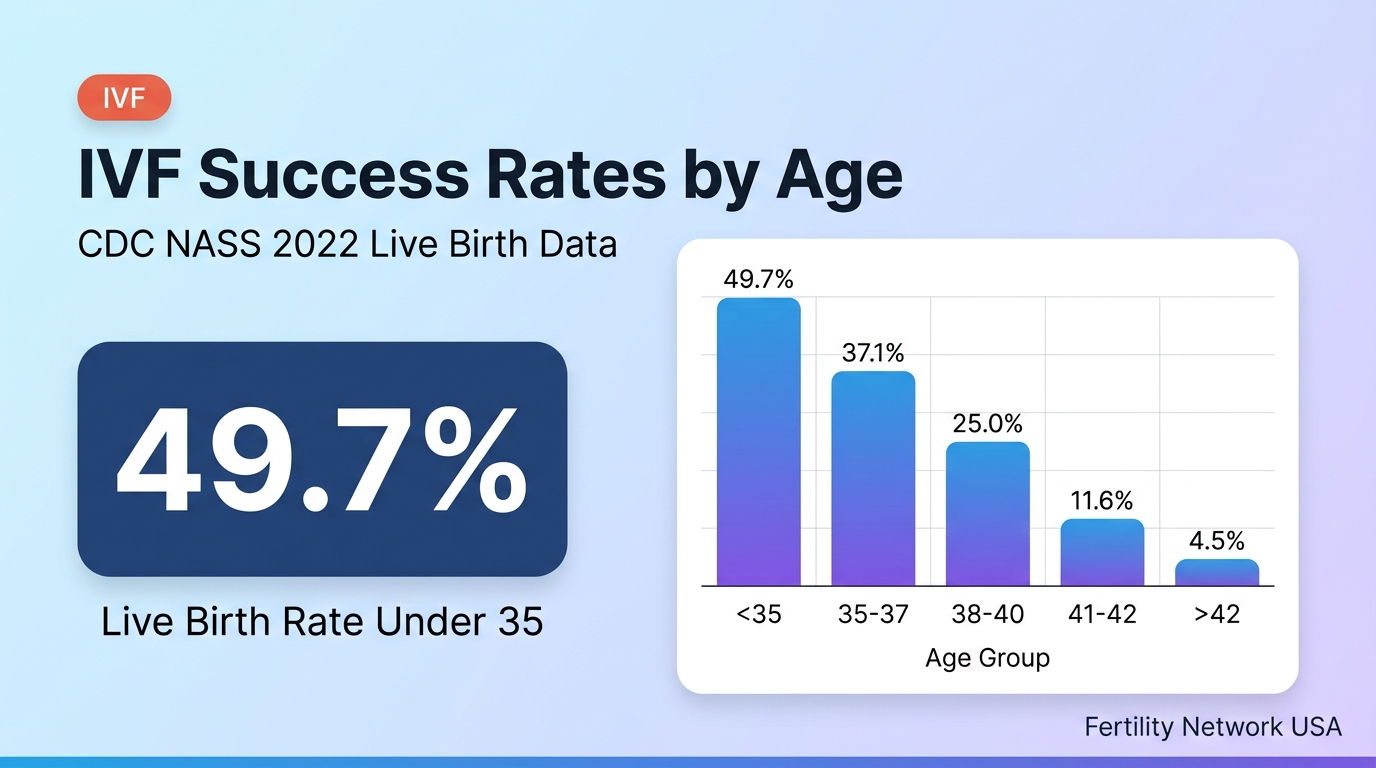
What is the IVF success rate?
The IVF live birth rate per egg retrieval ranges from 49.7% for women under 35 to 4.3% for women over 42 using their own eggs, according to the CDC National ART Surveillance System (NASS) 2022 Annual Report. This report collects mandatory outcome data from all 449 ART-reporting clinics in the United States under the Fertility Clinic Success Rate and Certification Act of 1992.
The CDC measures IVF success in two ways: live birth rate per egg retrieval and live birth rate per embryo transfer. Live birth rate per retrieval is the more conservative metric — it divides the number of live births by all cycles that began egg retrieval, including cycles cancelled before transfer due to poor embryo development or no viable embryos. Live birth rate per transfer excludes cancelled cycles and is therefore a higher number that overstates real-world outcomes for most patients.
| Patient Age Group | Live Birth Rate / Retrieval (Own Egg) | Live Birth Rate / Transfer (Own Egg) | Cancellation Rate |
|---|---|---|---|
| Under 35 | 49.7% | 51.2% | ~3% |
| Age 35–37 | 35.4% | 38.6% | ~8% |
| Age 38–40 | 23.1% | 27.8% | ~17% |
| Age 41–42 | 11.6% | 16.3% | ~29% |
| Over 42 | 4.3% | 8.1% | ~47% |
| Donor egg (any age) | N/A (donor retrieval) | 40–52% | ~4% |
What is the IVF success rate for women under 35?
The IVF live birth rate per egg retrieval for women under 35 using their own eggs is 49.7% — meaning nearly 1 in 2 retrieval cycles results in a live birth for this age group (CDC NASS 2022). The live birth rate per embryo transfer for the same group is 51.2%.
Women under 35 benefit from the highest IVF success rates because egg quality and quantity are at their peak in this age range. Ovarian reserve — measured by AMH (anti-Müllerian hormone) and antral follicle count (AFC) — is highest before age 35. Higher ovarian reserve produces more eggs per stimulation cycle, increasing the number of blastocysts available for transfer or cryopreservation.
Embryo aneuploidy rates are also lowest for women under 35 — approximately 30–40% of blastocysts carry chromosomal abnormalities in this age group, compared to over 75% for women over 42. Lower aneuploidy rates mean a higher proportion of transferred embryos implant successfully and develop to term.
How does IVF success rate change after age 35?
The IVF live birth rate per retrieval drops from 49.7% for women under 35 to 35.4% for women aged 35–37 — a 14.3 percentage point decline over just 2–3 years (CDC NASS 2022). This decline reflects the accelerating loss of egg quality and ovarian reserve that begins in the mid-30s.
The decline in IVF success rate between ages 35 and 37 is driven primarily by two factors: rising embryo aneuploidy rates and declining ovarian reserve. Aneuploidy rates increase from approximately 40% of blastocysts at age 35 to 50% at age 37. AMH levels begin declining measurably after age 35, reducing average egg yield per stimulation cycle from 10–15 eggs at age 32 to 8–12 eggs at age 37.
For women in this age group, ASRM recommends considering PGT-A to identify euploid (chromosomally normal) embryos before transfer, particularly if the patient has had a prior miscarriage or failed IVF cycle. Transferring a single PGT-A-confirmed euploid blastocyst achieves a 60–70% live birth rate per transfer for patients aged 35–37.
What is the IVF success rate for women aged 38–40?
The IVF live birth rate per egg retrieval for women aged 38–40 using their own eggs is 23.1% — less than half the rate for women under 35 (CDC NASS 2022). The live birth rate per transfer for this group is 27.8%, with a cycle cancellation rate of approximately 17%.
At ages 38–40, embryo aneuploidy rates reach 55–65% of blastocysts. Fewer eggs per retrieval cycle — averaging 6–10 eggs — means fewer blastocysts are available for PGT-A screening, and a higher proportion of screened embryos test aneuploid. Patients in this age group who produce 3 or more euploid blastocysts after PGT-A have a cumulative live birth rate of 60–80% over multiple transfers.
| Eggs Retrieved | Expected Blastocysts | Expected Euploid Blastocysts (Age 38–40) | Cumulative Live Birth Rate |
|---|---|---|---|
| 4–6 eggs | 1–2 blastocysts | 0–1 euploid embryos | 25–35% |
| 7–10 eggs | 2–4 blastocysts | 1–2 euploid embryos | 40–55% |
| 11–15 eggs | 4–6 blastocysts | 2–3 euploid embryos | 65–80% |
What is the IVF live birth rate for women over 40?
The IVF live birth rate per retrieval using own eggs is 11.6% for women aged 41–42 and 4.3% for women over 42, according to CDC NASS 2022. The cycle cancellation rate for women over 42 reaches 47%, meaning nearly half of all retrieval cycles in this group produce no embryos suitable for transfer.
The steep decline in own-egg IVF success for women over 40 is caused by two compounding factors: severely diminished ovarian reserveand very high embryo aneuploidy rates. Aneuploidy rates exceed 75% of blastocysts for women over 42. AMH levels in this age group are typically below 0.5 ng/mL — classified as severely diminished ovarian reserve — resulting in average egg yields of 2–5 eggs per retrieval cycle.
Multiple IVF cycles — a strategy called egg or embryo banking— improve cumulative outcomes for women over 40. Banking embryos from 2–3 retrieval cycles before PGT-A testing increases the pool of embryos available for screening, improving the probability of identifying at least one euploid blastocyst. Donor egg IVF is recommended when own-egg cycles consistently yield no euploid embryos after 2–3 retrievals.
Does donor egg IVF have a higher success rate than own egg IVF?
Donor egg IVF achieves a 40–52% live birth rate per transfer regardless of the recipient's age, compared to 4.3% per retrieval for women over 42 using their own eggs (CDC NASS 2022). Donor egg IVF success depends on the donor's egg quality — not the recipient's ovarian function or age.
Egg donors in the United States are typically aged 21–32 and undergo comprehensive screening including genetic testing, ovarian reserve assessment (AMH and AFC), infectious disease screening, and psychological evaluation per FDA and ASRM guidelines. Using eggs from a donor under 30 with AMH above 2.5 ng/mL produces blastocysts with aneuploidy rates of 30–40% — equivalent to a 30-year-old own-egg cycle.
| IVF Type | Recipient Age | Live Birth Rate / Transfer | Aneuploidy Rate of Embryos |
|---|---|---|---|
| Own egg IVF | Under 35 | 51.2% | 30–40% |
| Own egg IVF | 41–42 | 16.3% | 70–75% |
| Own egg IVF | Over 42 | 8.1% | 75–85% |
| Donor egg IVF | Any age | 40–52% | 30–40% (donor-age dependent) |
Donor egg IVF is indicated for women with premature ovarian insufficiency (POI), severely diminished ovarian reserve (AMH below 0.3 ng/mL), repeated own-egg IVF failure producing no euploid embryos, or carriers of severe autosomal dominant genetic conditions who choose not to use PGT-M. For a full overview, see What Is Donor Egg IVF? Success Rates, Process, and Cost.
How is IVF success rate calculated in the CDC NASS report?
The CDC calculates IVF success rate as live birth rate per initiated ART cycle, per egg retrieval, and per embryo transfer — three distinct denominators that produce three different percentages for the same patient population. Each metric is reported separately in the NASS Annual Report.
| CDC Metric | What It Measures | Best For |
|---|---|---|
| Per initiated cycle | Live births ÷ all cycles that began stimulation | Most conservative overall measure |
| Per egg retrieval | Live births ÷ cycles that reached retrieval | Best for comparing clinics fairly |
| Per embryo transfer | Live births ÷ cycles that reached transfer | Useful for per-transfer embryo quality |
| Per intended egg retrieval | Live births ÷ cycles that planned retrieval (including cancelled) | Most patient-relevant metric |
The CDC collects this data under the Fertility Clinic Success Rate and Certification Act of 1992 (FCSRCA), which mandates that all US ART clinics report annual cycle outcomes to the CDC. The CDC then audits, verifies, and publishes this data approximately 2 years after the reporting year — meaning 2022 data was published in 2024. Self-reported clinic success rates are not audited and should not be used for clinic comparisons.
For a deeper explanation of how to read CDC NASS data versus SART data, see CDC NASS vs SART Data: What Is the Difference and Which Is More Accurate?.
What factors reduce IVF success rate?
5 patient factors independently reduce IVF success rate: advanced maternal age, diminished ovarian reserve, high embryo aneuploidy rate, uterine abnormalities, and prior failed IVF cycles. Each factor reduces the probability of live birth per cycle through a different biological mechanism.
How does ovarian reserve affect IVF success rate?
Low ovarian reserve reduces IVF success rate by producing fewer eggs per retrieval cycle, leaving fewer embryos available for transfer after quality selection. Ovarian reserve is quantified by AMH (anti-Müllerian hormone) level and antral follicle count (AFC).
| AMH Level | Classification | Expected Egg Yield | IVF Prognosis |
|---|---|---|---|
| Above 3.5 ng/mL | High (PCOS risk) | 15–30+ eggs | Excellent response; OHSS risk |
| 1.0–3.5 ng/mL | Normal | 10–15 eggs | Good prognosis |
| 0.5–1.0 ng/mL | Low normal | 5–10 eggs | Adequate prognosis |
| 0.3–0.5 ng/mL | Diminished | 2–5 eggs | Poor prognosis; consider banking |
| Below 0.3 ng/mL | Severely diminished | 0–3 eggs | Very poor; donor egg discussion |
AMH level alone does not determine IVF outcome — it predicts ovarian response (egg yield) but not egg quality. A 38-year-old with AMH of 3.0 ng/mL may produce many eggs, but a high proportion will be aneuploid due to age-related meiotic errors, independent of AMH level.
Does embryo quality affect IVF success rate?
Embryo quality is the single strongest predictor of IVF live birth rate per transfer. A Grade AA blastocyst (Gardner scale: full expansion, well-defined inner cell mass, cohesive trophectoderm) achieves a 60–70% live birth rate per transfer; a Grade CC blastocyst achieves 15–25% per transfer, according to published embryology laboratory data (Gardner et al., 2000; updated ESHRE 2023 criteria).
Embryo quality is assessed at the blastocyst stage (day 5 or 6 of culture) using 3 criteria: blastocyst expansion grade (1–6, where 5 = hatching), inner cell mass (ICM) grade (A = tightly packed, B = loosely grouped, C = very few cells), and trophectoderm grade (A = many cohesive cells, B = few large cells, C = very few cells). PGT-A adds chromosomal status to morphological grading, improving selection accuracy.
Does the number of previous IVF cycles affect success rate?
Prior failed IVF cycles reduce the probability of success in subsequent cycles only if the failure is caused by a persistent, uncorrected factor — such as untreated hydrosalpinx, undiagnosed endometrial polyp, thyroid dysfunction, or embryo chromosomal abnormality without PGT-A testing. Failed cycles caused by poor embryo quality alone do not reduce the per-cycle probability of future success if higher-quality embryos are available.
Recurrent implantation failure (RIF) — defined as 3 or more failed transfers of morphologically normal embryos — requires investigation with uterine evaluation (sonohysterogram or hysteroscopy), thrombophilia panel, and immunological workup before proceeding with additional transfers.
Frequently Asked Questions
What IVF success rate should I expect at my specific clinic?+
Your clinic's CDC NASS success rate for your specific age group is the most accurate predictor of your per-cycle outcome at that clinic. Individual success rates vary by clinic due to differences in laboratory quality, embryologist experience, stimulation protocols, and patient selection. Use the CDC NASS data published for each clinic — not self-reported success rates — when comparing clinics. You can find CDC-verified success rates for every clinic in our fertility clinic directory.
Is a 50% IVF success rate per cycle or cumulative?+
The 49.7% CDC NASS rate is per single egg retrieval cycle — not cumulative across multiple cycles. Cumulative live birth rates are significantly higher. After 3 complete IVF cycles, the cumulative live birth rate for women under 35 reaches 65–80%, according to ASRM multi-cycle outcome data. After 6 cycles, cumulative rates exceed 85% for patients with normal ovarian reserve and good-quality embryos.
Why do different clinics report different success rates for the same age group?+
Clinic success rates differ due to 4 factors: laboratory quality, patient selection criteria, embryo transfer policy, and the proportion of donor egg cycles in the clinic's data. Clinics that accept more complex cases (older patients, prior failures, low reserve) will have lower CDC success rates than clinics with more selective patient acceptance. Clinics with a high proportion of donor egg cycles will show higher overall success rates because donor egg IVF consistently outperforms own-egg IVF in older age groups. Always compare CDC NASS rates for your specific age group and cycle type (own egg vs. donor egg).
Does IVF success rate improve with frozen embryo transfer?+
Frozen embryo transfer (FET) achieves a 6–8% higher live birth rate than fresh embryo transfer in most age groups (ASRM 2023). FET allows the endometrium to recover from the elevated estrogen levels produced during ovarian stimulation, improving uterine receptivity. Most US IVF programs now freeze all blastocysts and perform transfers in a separate FET cycle — a strategy called "freeze-all" — for this reason. For more detail, see Fresh vs Frozen Embryo Transfer: Which Has a Higher Live Birth Rate?.
Does PGT-A improve IVF success rate for all age groups?+
PGT-A improves per-transfer live birth rate for women over 37 and patients with prior miscarriage or implantation failure, but shows limited benefit for women under 35 with normal ovarian reserve. For women aged 38–40, PGT-A increases per-transfer live birth rate from 27.8% (untested embryos) to 55–65% (euploid embryos only). The benefit is lower for younger patients because the baseline aneuploidy rate is lower, and the risk of discarding a mosaic embryo that could have implanted is higher. For more detail, see PGT-A vs No PGT: Does Genetic Testing Improve IVF Live Birth Rates?.
Fertility Network USA is an independent information directory. All success rates in this article are sourced directly from the CDC National ART Surveillance System (NASS) 2022 Annual Report and ASRM clinical practice guidelines. Individual outcomes vary significantly by clinic, patient diagnosis, ovarian reserve, embryo quality, and specific treatment protocol. This article does not constitute medical advice, a diagnosis, or a treatment recommendation. Always consult a board-certified reproductive endocrinologist before making fertility treatment decisions.