What is IVF?
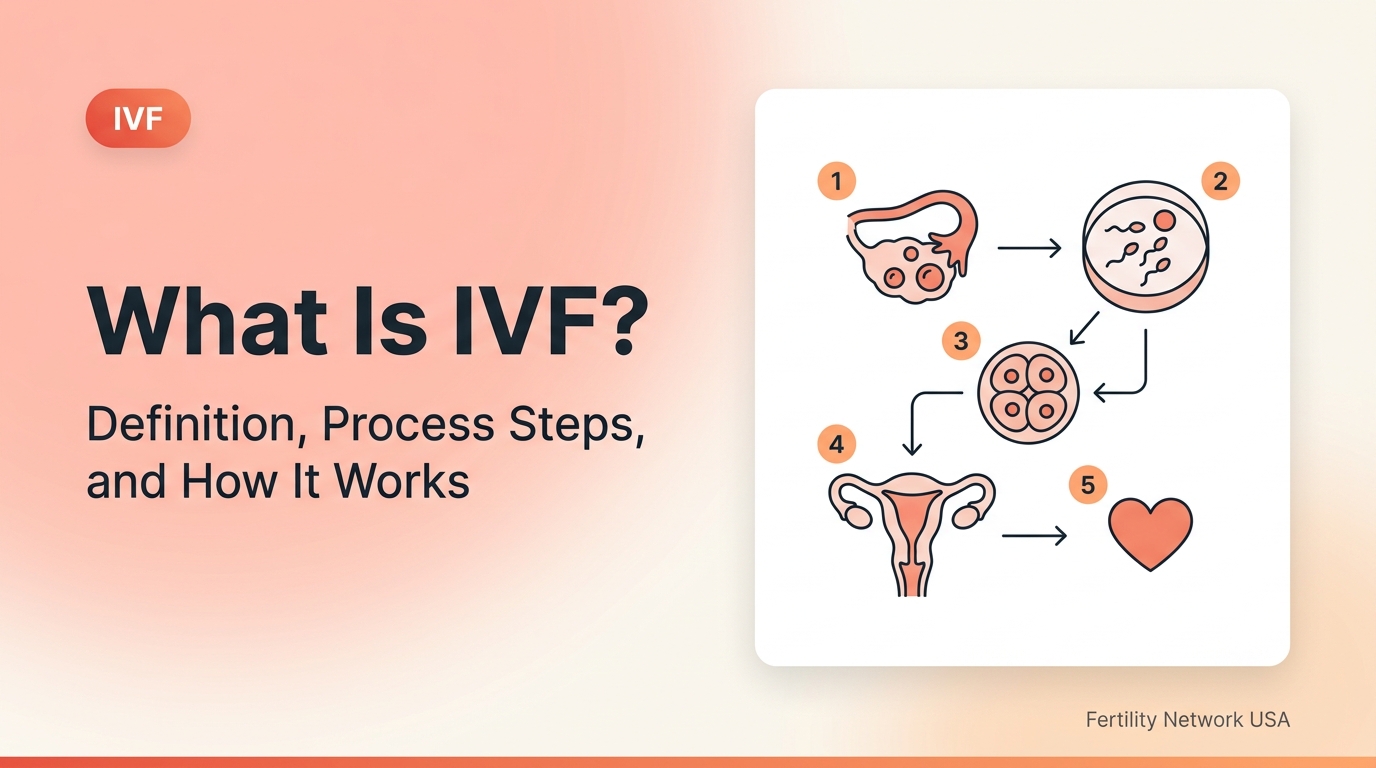
IVF (in vitro fertilization) is an assisted reproductive technology (ART) procedure in which a woman's eggs are retrieved from her ovaries, fertilized by sperm in a laboratory dish, and the resulting embryo is transferred into the uterus to achieve pregnancy. The term "in vitro" is Latin for "in glass," referring to the laboratory environment where fertilization occurs outside the body.
IVF is classified as ART by the Centers for Disease Control and Prevention (CDC) because it involves the direct handling of both eggs and embryos. Fertility treatments that only handle sperm — such as intrauterine insemination (IUI) — are not classified as ART under the CDC's reporting framework.
The first successful IVF birth occurred on July 25, 1978, when Louise Brown was born in the United Kingdom. In the United States, the first IVF birth took place in 1981. Since then, more than 8 million babies have been born worldwide through IVF and other ART procedures.
How does IVF work step by step?
A complete IVF cycle involves 8 sequential steps: ovarian stimulation, monitoring, egg retrieval, sperm preparation, fertilization, embryo culture, genetic testing (if selected), and embryo transfer — followed by a luteal phase support period and pregnancy test.
Ovarian stimulation
Injectable gonadotropin medications — including FSH (follicle-stimulating hormone), LH (luteinizing hormone), or both — stimulate the ovaries to produce multiple follicles simultaneously. A standard stimulation protocol targets the development of 10–15 mature follicles. Stimulation lasts 8–14 days.
Monitoring
Transvaginal ultrasound and blood tests measuring estradiol and LH levels are performed every 1–3 days during stimulation. Monitoring confirms follicle growth and determines the optimal trigger timing. Premature ovulation is prevented using GnRH antagonists or agonists depending on protocol.
Trigger injection
An hCG (human chorionic gonadotropin) or GnRH agonist injection triggers final egg maturation. Egg retrieval is scheduled exactly 36 hours after the trigger injection to coincide with egg release before natural ovulation occurs.
Egg retrieval (oocyte retrieval)
A reproductive endocrinologist uses a transvaginal ultrasound-guided needle to aspirate follicular fluid from each follicle while the patient is under intravenous sedation. An embryologist immediately identifies eggs (oocytes) in the follicular fluid. The procedure takes 15–20 minutes.
Sperm preparation
The male partner's semen sample — or a donor sperm sample — is processed in the laboratory to select motile sperm using density gradient centrifugation or swim-up technique. Sperm preparation removes debris, dead sperm, and seminal plasma, concentrating the highest-quality motile sperm.
Fertilization
Mature eggs are fertilized using either conventional IVF(placing 50,000–100,000 sperm in a dish with each egg) or ICSI (injecting one sperm directly into each egg). Fertilization confirmation occurs 16–18 hours later via pronuclei assessment. Normal fertilization produces a 2-pronuclei (2PN) zygote.
Embryo culture
Fertilized eggs develop in a temperature-controlled incubator for 5–6 days, reaching the blastocyst stage. A blastocyst contains 60–200 cells and consists of an inner cell mass (which becomes the fetus) and an outer trophectoderm (which becomes the placenta). Day-5 blastocysts have a higher implantation rate than day-3 cleavage-stage embryos.
Embryo transfer
A thin catheter passes through the cervix under ultrasound guidance to deposit the embryo into the uterine cavity. Transfer takes 5–10 minutes and requires no anesthesia. A fresh transfer occurs on day 5 of embryo culture; a frozen embryo transfer (FET) occurs in a subsequent cycle after endometrial preparation.
What happens during ovarian stimulation?
Ovarian stimulation uses injectable gonadotropin medications to cause the ovaries to develop multiple follicles simultaneously, rather than the single follicle that matures naturally each menstrual cycle. Each follicle contains one egg. The goal is to retrieve 10–15 mature eggs per cycle to maximize the chance of creating viable embryos.
Two primary stimulation protocols are used: the GnRH antagonist protocol(short protocol, more common in the US) and the GnRH agonist protocol(long protocol). The antagonist protocol begins stimulation on cycle day 2 or 3 and adds a GnRH antagonist from day 5 onward to suppress premature LH surges. The agonist protocol starts a GnRH agonist in the preceding luteal phase to achieve pituitary suppression before stimulation begins.
How are eggs retrieved in an IVF cycle?
Eggs are retrieved by transvaginal ultrasound-guided follicular aspiration, a minimally invasive procedure performed under intravenous sedation in an outpatient setting. A reproductive endocrinologist inserts a fine needle through the vaginal wall into each ovarian follicle and applies gentle suction to aspirate the follicular fluid containing the egg.
An embryologist examines the aspirated fluid under a microscope immediately after retrieval to identify mature (MII) eggs. Immature eggs (MI or GV stage) cannot be fertilized through conventional IVF or ICSI unless they undergo in vitro maturation (IVM). The average retrieval yield is 8–12 eggs per cycle for women under 35 with normal ovarian reserve.
How does fertilization occur in the laboratory?
Fertilization in IVF occurs by placing prepared sperm in a culture dish with mature eggs (conventional IVF) or by injecting one sperm directly into each mature egg (ICSI). Conventional IVF fertilization achieves a 60–70% fertilization rate per mature egg; ICSI achieves a 70–80% fertilization rate per mature egg.
ICSI is used in approximately 79% of all IVF cycles performed in the United States, according to CDC NASS 2022 data. ICSI is indicated for male factor infertility (low sperm count, poor motility, or abnormal morphology), prior fertilization failure with conventional IVF, and cycles using frozen or surgically retrieved sperm.
What is the embryo transfer process?
Embryo transfer deposits one or two embryos into the uterine cavity using a soft catheter passed through the cervix under abdominal ultrasound guidance. The American Society for Reproductive Medicine (ASRM) recommends single embryo transfer (SET) for most patients under 38 with good-quality embryos to minimize the risk of twin pregnancy, which carries significantly higher maternal and neonatal complication rates.
A fresh embryo transfer occurs 5–6 days after egg retrieval in the same cycle. A frozen embryo transfer (FET) occurs in a subsequent cycle after the retrieved embryos are vitrified and stored. FET cycles allow endometrial preparation without the concurrent effects of high estrogen from ovarian stimulation, and FET has a 6–8% higher live birth ratethan fresh transfer in most patient groups (ASRM 2023).
Who is IVF recommended for?
IVF is recommended for patients with 5 specific fertility diagnoses: bilateral tubal occlusion or tubal factor, severe male factor infertility, diminished ovarian reserve, unexplained infertility after 3–6 failed IUI cycles, and a clinical indication for preimplantation genetic testing (PGT-A or PGT-M).
| Diagnosis | Why IVF Is Indicated | Alternative |
|---|---|---|
| Bilateral tubal occlusion | Eggs cannot travel to the uterus naturally | None — IVF bypasses tubes entirely |
| Severe male factor infertility | Sperm count or motility insufficient for IUI | ICSI-IVF with surgically retrieved sperm |
| Diminished ovarian reserve | Low AMH or high FSH reduces IUI success probability | Donor egg IVF if own-egg IVF fails |
| Unexplained infertility | 3–6 IUI failures; IVF provides controlled fertilization | IUI (lower success rate) |
| PGT indication | Embryo genetic screening requires IVF to create embryos | None — PGT-A requires IVF |
| Same-sex female couples | Egg retrieval + donor sperm; one partner or both can participate | IUI with donor sperm (lower success rate) |
What is the IVF success rate according to CDC NASS 2022?
The IVF live birth rate per egg retrieval for women under 35 using their own eggs is 49.7%, according to the CDC National ART Surveillance System (NASS) 2022 Annual Report — the most recent federally published ART dataset as of 2026.
| Patient Age Group | Live Birth Rate Per Retrieval (Own Egg) | Live Birth Rate Per Transfer |
|---|---|---|
| Under 35 | 49.7% | 51.2% |
| Age 35–37 | 35.4% | 38.6% |
| Age 38–40 | 23.1% | 27.8% |
| Age 41–42 | 11.6% | 16.3% |
| Over 42 | 4.3% | 8.1% |
| Donor egg (any age) | N/A (donor retrieval) | 40–52% |
Live birth rate per egg retrieval is the most clinically accurate metric because it accounts for cycles cancelled before transfer due to poor embryo development. Live birth rate per transfer is higher but excludes cancelled cycles, making it a less conservative success estimate.
How long does one IVF cycle take?
One complete IVF cycle takes 4 to 6 weeks from the start of ovarian stimulation to the result of the pregnancy test following embryo transfer. This timeline assumes a fresh embryo transfer; a frozen embryo transfer (FET) in a subsequent cycle adds an additional 4–6 weeks for endometrial preparation.
| IVF Phase | Duration | Key Activities |
|---|---|---|
| Pre-cycle baseline testing | 1–2 weeks | AMH, FSH, antral follicle count, uterine evaluation |
| Ovarian stimulation | 8–14 days | Daily injections, monitoring ultrasounds every 1–3 days |
| Trigger + egg retrieval | 36 hours after trigger | hCG or GnRH agonist trigger; retrieval under sedation |
| Embryo culture | 5–6 days | Fertilization, division, blastocyst development |
| Fresh embryo transfer | Day 5 or 6 post-retrieval | Catheter transfer under ultrasound guidance |
| Luteal phase support | 14 days post-transfer | Progesterone supplementation; pregnancy test at day 14 |
What is the difference between IVF and ICSI?
IVF fertilizes eggs by mixing them with thousands of sperm in a culture dish; ICSI (intracytoplasmic sperm injection) injects a single sperm directly into each mature egg. Both procedures share the same ovarian stimulation, egg retrieval, embryo culture, and embryo transfer steps. The only difference is the fertilization method used in the laboratory.
ICSI is used in approximately 79% of all IVF cycles in the United States. ICSI is required for severe male factor infertility with sperm parameters below WHO 2021 reference values — specifically, sperm concentration below 16 million/mL, total motility below 42%, or morphology below 4% normal forms. ICSI is also used for cycles using frozen sperm, surgically retrieved sperm (TESA, TESE, MESA), or embryos requiring PGT-A biopsy.
For more detail, see What Is ICSI (Intracytoplasmic Sperm Injection)? Definition, Process, and Indications.
What are the risks of IVF?
IVF carries 5 primary medical risks: ovarian hyperstimulation syndrome (OHSS), multiple pregnancy, egg retrieval complications, ectopic pregnancy, and embryo chromosomal abnormality. The clinical significance of each risk varies by patient age, ovarian reserve, and stimulation protocol.
- Ovarian hyperstimulation syndrome (OHSS): Occurs in 1–2% of IVF cycles in severe form. OHSS causes ovarian enlargement, fluid accumulation, and electrolyte imbalance. GnRH antagonist protocols and agonist triggers significantly reduce severe OHSS risk compared to older long agonist protocols.
- Multiple pregnancy: Transferring 2 or more embryos increases twin pregnancy risk to 20–30%. Twin pregnancies carry 5× higher rates of preterm birth, low birth weight, and maternal complications compared to singleton pregnancies. ASRM recommends single embryo transfer (SET) for most patients under 38.
- Egg retrieval complications: Bleeding, infection, or injury to adjacent structures (bowel, bladder, blood vessels) occur in fewer than 1 in 1,000 retrievals. Anesthetic reactions are the most common complication.
- Ectopic pregnancy: Occurs in approximately 1.5–2% of IVF pregnancies. Ectopic pregnancy risk is elevated in patients with prior tubal disease or pelvic inflammatory disease.
- Chromosomal abnormality: Embryo aneuploidy rate increases with maternal age — from 30–40% of blastocysts in women under 35 to over 75% in women over 42. PGT-A (preimplantation genetic testing for aneuploidies) screens embryos for chromosomal abnormalities before transfer.
Frequently Asked Questions
What is the difference between IVF and IUI?+
IVF retrieves eggs from the ovaries and fertilizes them in a laboratory; IUI places washed sperm directly into the uterus at ovulation. IVF is classified as ART by the CDC because it handles eggs and embryos outside the body; IUI is not classified as ART. The IVF live birth rate per cycle for women under 35 is 49.7% (CDC NASS 2022); the IUI success rate per cycle is 10–20%. For a detailed comparison, see IVF vs IUI: Success Rates, Cost Difference, and When to Choose Each.
How much does IVF cost in the United States?+
The average IVF cost per cycle in the United States is $12,000 to $15,000 before medications. Medications add $3,000 to $6,000 per cycle depending on the stimulation protocol and patient response. Total out-of-pocket costs per cycle average $15,000 to $30,000. 21 US states plus Washington DC have fertility insurance mandates that may cover part or all of IVF costs. For full cost details by state, see IVF Cost in the USA: Average Price Per Cycle, by State, and Hidden Fees.
Can IVF be done with donor eggs?+
IVF with donor eggs uses eggs retrieved from a screened egg donor instead of the recipient's own eggs. Donor egg IVF achieves a 40–52% live birth rate per transfer regardless of the recipient's age, because success depends on the donor's egg quality, not the recipient's ovarian function. Donor egg IVF is indicated for women with diminished ovarian reserve, premature ovarian insufficiency (POI), or repeated IVF failure using their own eggs.
What is a frozen embryo transfer (FET)?+
A frozen embryo transfer (FET) thaws a previously vitrified (flash-frozen) embryo and transfers it to the uterus in a separate cycle. FET allows the uterus to recover from ovarian stimulation before transfer, improving endometrial receptivity. FET live birth rates exceed fresh transfer rates by 6–8% in most age groups (ASRM 2023). Most IVF programs now freeze all embryos at the blastocyst stage and transfer in a subsequent FET cycle.
Does IVF increase the risk of birth defects?+
IVF is associated with a slightly elevated risk of birth defects compared to natural conception — approximately 4–5% vs. 3% for spontaneous pregnancies. This elevated risk is partly attributable to the underlying infertility diagnosis rather than the IVF procedure itself. ICSI does not independently increase birth defect risk beyond the risk associated with paternal sperm abnormalities. Large-scale studies from ASRM and the European Society of Human Reproduction and Embryology (ESHRE) confirm that the absolute risk increase is small.
Fertility Network USA is an independent information directory. This article contains clinical information for educational purposes only. It does not constitute medical advice, a diagnosis, or a treatment recommendation. All clinical outcome data is sourced from the CDC National ART Surveillance System (NASS) 2022 Annual Report and ASRM clinical practice guidelines. Always consult a board-certified reproductive endocrinologist before making fertility treatment decisions. Success rates vary significantly by clinic, individual patient factors, and specific diagnosis.