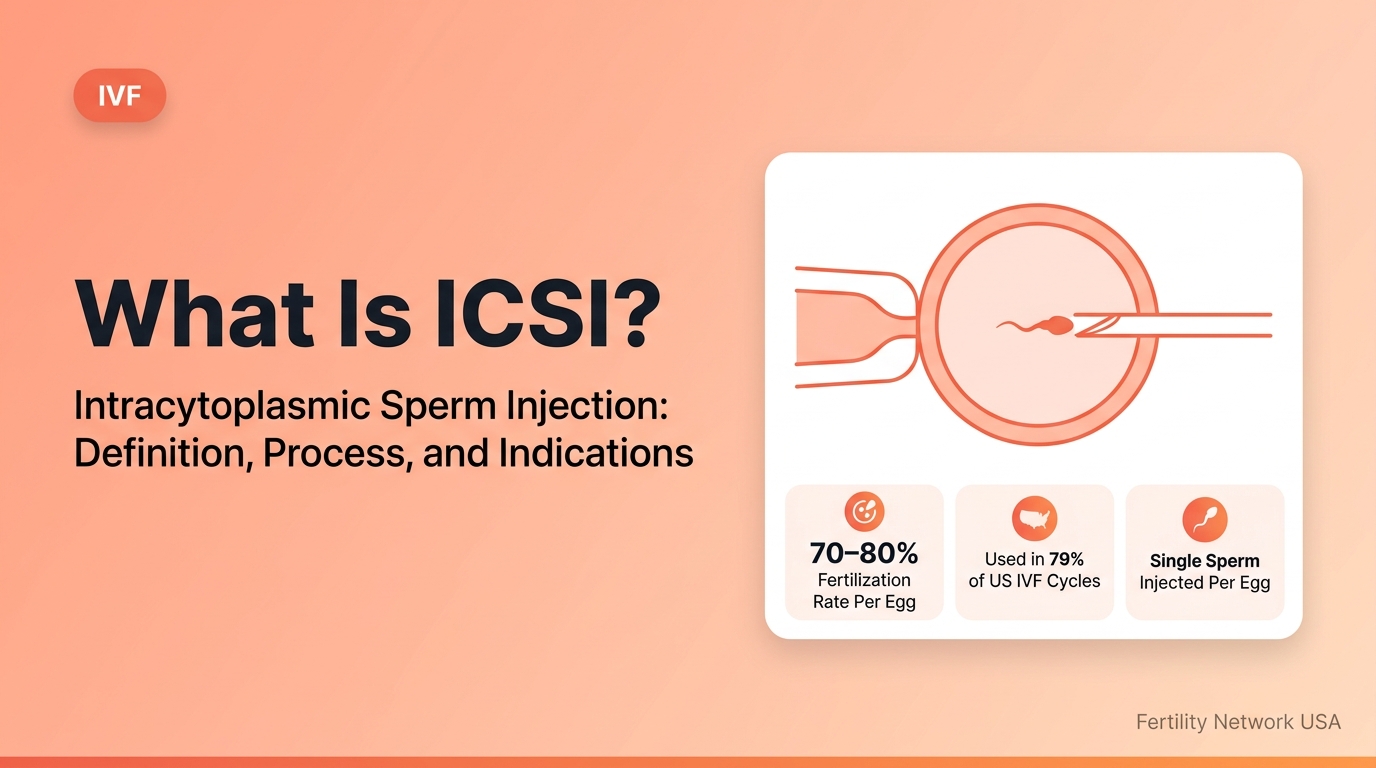
What is ICSI?
ICSI (intracytoplasmic sperm injection) is a micromanipulation fertilization technique in which a single selected sperm is immobilized, drawn into a fine glass micropipette, and injected directly into the cytoplasm of a mature egg (MII oocyte). The embryologist performs ICSI under high-powered inverted microscopy (200–400× magnification) using a micromanipulator — a precision mechanical system that controls micropipette movement in increments of microns.
ICSI was first successfully performed in humans by Palermo et al. at the Vrije Universiteit Brussel (VUB) in Belgium in 1992. Before ICSI, patients with severe male factor infertility had no viable IVF fertilization option — conventional IVF required a minimum sperm concentration that severe male factor patients could not meet. ICSI eliminated the minimum sperm count requirement for IVF fertilization, requiring only one viable sperm per mature egg.
How is ICSI performed differently from conventional IVF fertilization?
Conventional IVF fertilization places 50,000–100,000 prepared sperm in a droplet with each mature egg and allows sperm to penetrate the egg naturally; ICSI injects one selected sperm directly into each egg's cytoplasm, bypassing zona pellucida penetration entirely. Both methods are performed on the day of egg retrieval. The choice between conventional IVF and ICSI is made by the embryologist and reproductive endocrinologist based on sperm parameters and the cycle's clinical indication.
| Factor | Conventional IVF Fertilization | ICSI |
|---|---|---|
| Sperm quantity needed per egg | 50,000 – 100,000 motile sperm | 1 sperm per egg |
| Sperm penetration method | Natural — sperm penetrates zona pellucida unaided | Mechanical — embryologist injects through zona pellucida |
| Fertilization rate per mature egg | 60 – 70% | 70 – 80% |
| Minimum TMSC required | 500,000+ total motile sperm (washed sample) | No minimum — 1 viable sperm per egg |
| Male factor infertility | Ineffective for severe male factor | Effective regardless of sperm count |
| Oocyte damage risk | None from fertilization method | 1 – 3% egg damage per injected egg |
| US IVF cycle usage (CDC 2022) | ~21% of IVF cycles | ~79% of IVF cycles |
| Required for PGT-A biopsy cycles? | No — but ICSI preferred to avoid sperm DNA contamination | Yes — ICSI is standard for all PGT cycles |
How is ICSI performed in the laboratory?
ICSI is performed by a clinical embryologist using an inverted microscope equipped with hydraulic micromanipulators, a holding pipette to stabilize the egg, and a fine injection micropipette to deliver the sperm. The procedure is performed on each mature egg individually and takes 30–60 minutes total for a typical retrieval cycle of 10–15 eggs.
Egg preparation — removal of cumulus cells
Before ICSI, the embryologist removes the cumulus cells surrounding each egg using a brief exposure to hyaluronidase enzyme and gentle pipetting. This exposes the egg's surface and allows the embryologist to assess maturity — only MII (metaphase II) oocyteswith a visible polar body are injected. Immature GV and MI eggs are set aside; they cannot be fertilized by ICSI.
Sperm selection
The embryologist examines the prepared sperm sample under 400× magnification and selects individual sperm based on 3 morphological criteria: normal oval head shape, intact mid-piece, and a single long tail without coiling. A motile sperm with normal morphology is selected using a fine injection pipette. Advanced selection techniques — IMSI (intracytoplasmic morphologically selected sperm injection at 6,000× magnification) and PICSI (physiological ICSI using hyaluronan binding) — are available at specialized centers for patients with very high sperm DNA fragmentation.
Sperm immobilization
The selected sperm is immobilized by pressing the injection pipette across its tail to disrupt the axoneme (the sperm tail's structural core). Immobilization is required before injectionto prevent sperm tail movement from damaging the egg's cytoplasm during injection, and to trigger the sperm's calcium release activation signal upon entering the oocyte.
Egg stabilization and injection
The mature egg is held in place by gentle suction on a holding pipette, with its polar body positioned at the 6 or 12 o'clock position to protect the meiotic spindle. The injection pipette — containing the immobilized sperm — is advanced through the zona pellucida and the oolemma (egg cell membrane) into the cytoplasm. The sperm is gently deposited by injecting a minimal volume of medium into the cytoplasm, then the pipette is withdrawn. The entire injection takes under 60 seconds per egg.
Fertilization assessment (16–18 hours post-ICSI)
Fertilization is confirmed 16–18 hours after ICSI by examining each injected egg under the microscope for the presence of 2 pronuclei (2PN) — one from the egg and one from the sperm. A 2PN zygote confirms normal fertilization. 1PN and 3PN zygotes indicate abnormal fertilization and are not cultured further. Eggs with no pronuclei failed to fertilize. The embryologist records the fertilization rate for the cycle.
When is ICSI required over standard IVF?
ICSI is required for 5 specific clinical indications: severe male factor infertility, azoospermia with surgically retrieved sperm, prior conventional IVF fertilization failure, frozen sperm cycles with low post-thaw motility, and all PGT-A cycles, according to ASRM Practice Committee guidelines (2023).
| Indication | ICSI Required? | Reason |
|---|---|---|
| Severe male factor infertility (TMSC below 5M, or WHO criteria not met) | Yes — required | Insufficient motile sperm for conventional IVF fertilization |
| Azoospermia (no sperm in ejaculate) with TESA/TESE/MESA surgically retrieved sperm | Yes — required | Surgically retrieved sperm is limited in number; ICSI uses 1 per egg |
| Prior conventional IVF fertilization failure (0 or very few eggs fertilized in prior cycle) | Yes — required | Unexplained fertilization failure suggests sperm-egg binding defect |
| Frozen sperm with low post-thaw motility (TMSC below 500,000 after thaw) | Yes — required | Insufficient motile sperm after cryopreservation-related motility loss |
| PGT-A or PGT-M cycles (embryo biopsy for genetic testing) | Yes — standard practice | Prevents contamination of embryo biopsy sample with residual sperm DNA on egg surface |
| High sperm DNA fragmentation (DFI above 25–30%) | Yes — recommended | Conventional IVF may not overcome DNA damage; ICSI allows sperm selection |
| Normal sperm parameters (WHO 2021 criteria met; no prior IVF failure) | No — ASRM does not recommend routine ICSI | Conventional IVF achieves equivalent live birth rates without ICSI cost or oocyte damage risk |
Does ICSI improve IVF success rates?
ICSI improves IVF fertilization rates for patients with male factor infertility but does not improve live birth rates over conventional IVF in patients with normal sperm parameters. A 2022 Cochrane systematic review of 8 randomized controlled trials found no statistically significant difference in live birth rate between ICSI and conventional IVF for patients with non-male factor infertility (RR 1.04, 95% CI 0.89–1.20).
Despite this evidence, ICSI is used in 79% of all US IVF cycles(CDC NASS 2022), including many cycles where male factor infertility is absent. This widespread use reflects 3 factors: clinician preference for the higher and more predictable ICSI fertilization rate, the requirement for ICSI in all PGT-A cycles, and the fact that ICSI eliminates the risk of total fertilization failure from unexpected sperm-egg binding defects — which occurs in 1–3% of conventional IVF cycles even with normal sperm.
What is the fertilization rate with ICSI?
ICSI achieves a 70–80% fertilization rate per mature (MII) egg injected, meaning 7–8 of every 10 mature eggs successfully fertilize to produce a 2-pronuclei (2PN) zygote after ICSI. The remaining 20–30% of injected eggs fail to fertilize due to egg activation failure, egg degeneration caused by injection trauma, or abnormal fertilization producing 1PN or 3PN zygotes.
| ICSI Outcome | Rate Per Mature Egg Injected | Clinical Significance |
|---|---|---|
| Normal fertilization (2PN) | 70 – 80% | Embryo cultured to blastocyst stage |
| Egg degeneration (damaged during injection) | 1 – 3% | Egg unusable; operator skill dependent |
| Failed activation (no pronuclei — 0PN) | 5 – 15% | Fertilization did not occur despite injection |
| Abnormal fertilization (1PN or 3PN) | 5 – 10% | Not cultured further; discarded |
| Blastocyst development (of 2PN zygotes) | 40 – 60% | Suitable for transfer or vitrification |
Fertilization rate after ICSI is influenced by 3 laboratory variables: embryologist technical skill and experience, egg maturity at the time of injection (MII vs MI), and the cryoprotectant medium quality used during injection. Clinic-to-clinic ICSI fertilization rates vary from 60–85% due to these factors, making embryology laboratory quality a critical consideration when selecting a fertility clinic.
What is ICSI with surgically retrieved sperm?
ICSI with surgically retrieved sperm enables IVF for men with azoospermia — the complete absence of sperm in the ejaculate — by extracting sperm directly from the testis or epididymis using a minor surgical procedure. Azoospermia affects approximately 1% of all men and 10–15% of infertile men. ICSI is the only viable fertilization method for azoospermic patients because surgically retrieved sperm quantities are too low for conventional IVF.
| Retrieval Procedure | Full Name | Indication | Sperm Source |
|---|---|---|---|
| TESA | Testicular sperm aspiration | Non-obstructive azoospermia (NOA) | Testicular tissue aspirated by needle |
| TESE | Testicular sperm extraction | Non-obstructive azoospermia (NOA) | Testicular tissue excised surgically; higher yield than TESA |
| Micro-TESE | Microsurgical testicular sperm extraction | Severe NOA (Sertoli-cell-only, maturation arrest) | Operating microscope identifies sperm-producing tubules; highest yield |
| MESA | Microsurgical epididymal sperm aspiration | Obstructive azoospermia (OA — CBAVD, vasectomy) | Epididymis aspirated microsurgically; highest motility sperm |
| PESA | Percutaneous epididymal sperm aspiration | Obstructive azoospermia (less severe) | Epididymis aspirated by needle; simpler than MESA |
Obstructive azoospermia (OA) — caused by vasectomy, congenital bilateral absence of the vas deferens (CBAVD), or prior infection — has sperm production rates of nearly 100% despite absent ejaculatory sperm. MESA or PESA retrieval achieves sperm in virtually all OA cases. Non-obstructive azoospermia (NOA) — caused by Klinefelter syndrome, Y-chromosome microdeletion, or chemotherapy damage — has impaired sperm production; micro-TESE finds sperm in 50–60% of NOA cases.
What are the risks of ICSI?
ICSI carries 3 primary risks: oocyte damage during injection (1–3% per egg), potential transmission of paternal genetic abnormalities, and a marginally elevated birth defect rate compared to conventional IVF. The clinical significance of each risk depends on the patient's specific diagnosis and the embryology laboratory's technical proficiency.
Oocyte damage (1–3% per injected egg) is the most direct ICSI-specific risk. An imprecise injection — breaking the oolemma without depositing sperm cleanly — causes egg degeneration within 1–2 hours. Damage rates above 5% per egg at a clinic indicate suboptimal embryologist technique and should prompt discussion before proceeding.
Genetic transmission risk is specific to patients with Y-chromosome microdeletions, CBAVD-associated CFTR mutations, or chromosomal translocations causing male factor infertility. Male offspring of fathers with Y-chromosome microdeletions (AZFc region) will inherit the deletion and will likely be infertile themselves, requiring ICSI for their own future fertility. PGT-M (preimplantation genetic testing for monogenic disease) can screen embryos for transmissible genetic conditions before transfer.
Birth defect rate: ICSI is associated with a marginally elevated birth defect rate (4–5%) compared to conventional IVF (3–4%) and spontaneous conception (3%). The excess risk is primarily attributable to the underlying paternal sperm abnormality — not the injection technique itself — based on large-scale cohort studies from the Belgian Centre for Reproductive Medicine (Bonduelle et al., updated 2022).
How much does ICSI add to the cost of an IVF cycle?
ICSI adds $1,000 to $2,500 to the base IVF cycle costand is billed as a separate laboratory add-on by most US fertility clinics. ICSI is not included in the standard IVF base price. The fee covers the embryologist's time (30–60 minutes per cycle), the use of specialized micromanipulation equipment, and the injection consumables (glass micropipettes, holding pipettes, and injection medium).
| Procedure | Average US Cost | Included in Base IVF? |
|---|---|---|
| IVF base cycle (monitoring, retrieval, culture, fresh transfer) | $12,000 – $15,000 | Yes |
| ICSI add-on | $1,000 – $2,500 | No — billed separately |
| IVF + ICSI (base + add-on) | $13,000 – $17,500 | Base + ICSI combined |
| IMSI (advanced sperm selection at 6,000×) | $500 – $1,500 additional | No — further add-on to ICSI |
| PICSI (physiological hyaluronan-binding sperm selection) | $300 – $800 additional | No — further add-on to ICSI |
ICSI is covered by fertility insurance mandates in states that cover IVF — including New York, Massachusetts, Illinois, and New Jersey — when medically indicated for male factor infertility. Routine ICSI without a male factor diagnosis may not be covered even in mandate states. For the full IVF and ICSI cost breakdown, see IVF Cost in the USA: Average Price Per Cycle, by State, and Hidden Fees.
Frequently Asked Questions
Can ICSI be used with donor sperm?+
ICSI can be performed with donor sperm and is used when the donor sperm vial has a low post-thaw total motile sperm count (TMSC) or when the cycle also requires PGT-A testing. Donor sperm vials from ASRM-accredited sperm banks are certified to contain a minimum of 10–20 million motile sperm post-thaw — sufficient for conventional IVF fertilization in most cases. ICSI with donor sperm is used when post-thaw TMSC is below 500,000, the cycle uses donor sperm for PGT-A testing, or if prior conventional IVF with donor sperm produced poor fertilization.
Does ICSI guarantee fertilization?+
ICSI does not guarantee fertilization — it achieves a 70–80% fertilization rate per mature egg, not 100%. Failed fertilization after ICSI occurs in 5–15% of injected mature eggs due to egg activation failure, in which the sperm does not trigger the calcium signaling cascade needed to complete meiosis. Total fertilization failure (0 of all eggs fertilizing) after ICSI occurs in approximately 1–3% of cycles. In cases of prior total fertilization failure after ICSI, calcium ionophore artificial activation is a rescue option offered at some specialized centers.
What is the difference between ICSI and IMSI?+
IMSI (intracytoplasmic morphologically selected sperm injection) performs sperm selection at 6,000× magnification compared to standard ICSI's 200–400×, allowing the embryologist to identify and exclude sperm with nuclear vacuoles (large intranuclear vacuoles are associated with higher sperm DNA fragmentation). IMSI is recommended for patients with high sperm DNA fragmentation index (DFI above 25–30%), very poor morphology (below 1% normal forms), or repeated ICSI failure with normal sperm parameters. IMSI adds $500–$1,500 to the ICSI cost and is available at specialized andrological centers.
Does the embryologist choose which sperm to inject?+
Yes — the embryologist selects each sperm individually based on morphological assessment under 200–400× magnification, choosing a motile sperm with a normal oval head, intact mid-piece, and single straight tail. Sperm with large heads (macrocephalic), round heads (globozoospermia), bent tails, cytoplasmic droplets, or nuclear vacuoles are excluded. The quality of sperm selection is a key variable in ICSI success and is directly dependent on the embryologist's training, experience, and the quality of the laboratory's optical equipment.
Is routine ICSI recommended for all IVF cycles?+
ASRM does not recommend routine ICSI for all IVF cycles when male factor infertility is absent. The 2020 ASRM Practice Committee opinion on ICSI states: "The routine use of ICSI for non–male factor infertility does not improve fertilization or pregnancy rates compared with conventional IVF." Despite this evidence-based guideline, 79% of US IVF cycles use ICSI, partly due to clinician preference and partly due to the 1–3% risk of unexpected conventional IVF fertilization failure. Patients with normal sperm who are offered ICSI should discuss the specific clinical rationale with their reproductive endocrinologist.
Fertility Network USA is an independent information directory. ICSI usage rates are sourced from the CDC National ART Surveillance System (NASS) 2022 Annual Report. Clinical indications, fertilization rates, and risk data are sourced from ASRM Practice Committee guidelines (2023) and peer-reviewed reproductive medicine literature including Cochrane systematic reviews. WHO 2021 reference values for sperm parameters are sourced from the WHO Laboratory Manual for Examination and Processing of Human Semen, 6th edition (2021). This article does not constitute medical advice. Always consult a board-certified reproductive endocrinologist before making fertility treatment decisions.