How much does IVF cost in the United States?
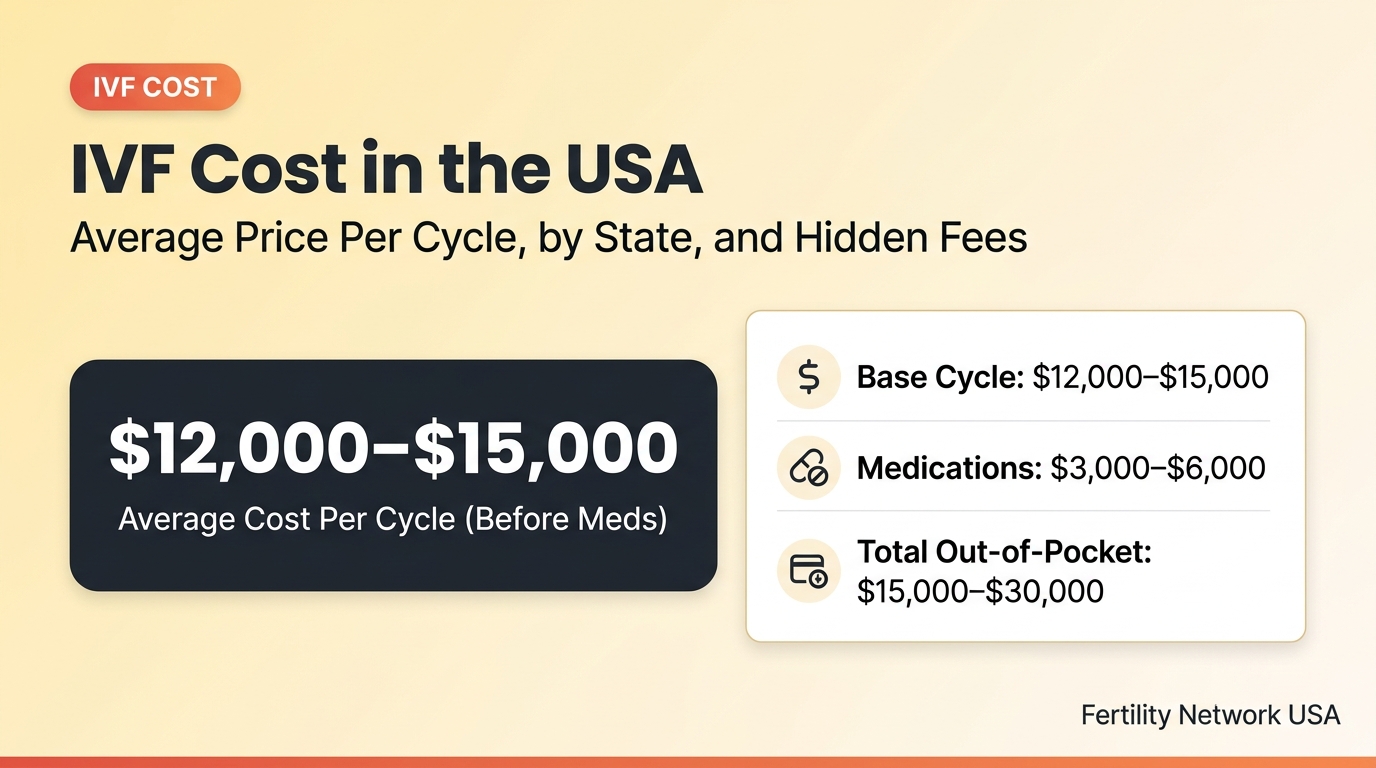
The average IVF cost per cycle in the United States is $12,000 to $15,000 for the base procedure before medications, according to RESOLVE: The National Infertility Association and FertilityIQ 2024 patient cost survey data. Adding gonadotropin medications ($3,000–$6,000), ICSI ($1,000–$2,500), and PGT-A genetic testing ($3,000–$8,000) brings the total cost of a single complete IVF cycle to $15,000 to $30,000 out of pocket for patients without insurance coverage.
| IVF Component | Average US Cost | Included in Base Price? |
|---|---|---|
| Base IVF cycle (monitoring, retrieval, lab, fresh transfer) | $12,000 – $15,000 | Yes |
| Gonadotropin medications (FSH, LH, antagonist) | $3,000 – $6,000 | No — billed separately |
| ICSI (intracytoplasmic sperm injection) | $1,000 – $2,500 | No — add-on procedure |
| PGT-A embryo genetic testing (per batch) | $3,000 – $8,000 | No — add-on procedure |
| Frozen embryo transfer (FET) cycle | $3,000 – $5,000 | No — separate cycle cost |
| Embryo cryopreservation (vitrification) | $1,000 – $2,000 | Sometimes included |
| Annual embryo storage | $500 – $1,000/year | No — ongoing fee |
| Initial consultation + baseline testing | $250 – $500 | No — pre-cycle cost |
| Total (base + medications + ICSI) | $16,000 – $22,500 | Most common out-of-pocket scenario |
| Total (base + meds + ICSI + PGT-A + FET) | $22,000 – $33,000 | Full-featured cycle with genetic testing |
What is included in the base IVF cycle cost?
A standard IVF base cycle price includes ovarian stimulation monitoring, egg retrieval, laboratory fertilization, embryo culture for 5–6 days, and one fresh embryo transfer. Most clinics also include the anesthesiologist fee for egg retrieval and the embryo transfer procedure fee in the base price.
The base IVF price typically covers 6 specific services: baseline ultrasound and bloodwork at cycle start, monitoring ultrasounds and estradiol blood tests during stimulation (2–5 visits), the egg retrieval procedure and anesthesia, embryologist fertilization and embryo culture for 5 days, embryologist grading and selection of transfer embryo, and the embryo transfer procedure with ultrasound guidance.
The following are not universally included in the base price and vary by clinic: gonadotropin prescription medications, ICSI, assisted hatching, embryo cryopreservation (vitrification), annual embryo storage, PGT-A biopsy and genetic analysis, the frozen embryo transfer cycle, progesterone and estrogen medications for FET preparation, and the pregnancy blood test (beta-hCG) 14 days after transfer.
What additional costs are not included in the IVF base price?
4 add-on costs most commonly increase IVF total cost beyond the advertised base price: gonadotropin medications, ICSI, PGT-A genetic testing, and the frozen embryo transfer cycle. Together, these 4 additions can increase the total cost of one IVF attempt by $8,000–$18,000 above the base price.
How much do IVF medications cost?
IVF gonadotropin medications cost $3,000 to $6,000 per cyclefor a standard stimulation protocol and are almost always billed separately from the base IVF price. Gonadotropins include FSH (follicle-stimulating hormone) products such as Gonal-F, Follistim, and Menopur, and GnRH antagonists such as Ganirelix and Cetrotide used to prevent premature ovulation.
Medication costs vary significantly based on 3 factors: the stimulation protocol selected by the reproductive endocrinologist, the patient's ovarian reserve and response (higher AMH = fewer units of medication needed), and the pharmacy used. Specialty fertility pharmacies — including Schraft's Specialty Pharmacy, MDR Pharmacy, and Freedom Fertility Pharmacy — offer significantly lower prices than retail pharmacies and can reduce medication costs by 20–40%. Manufacturer compassionate use programs from EMD Serono (Gonal-F) and Merck (Follistim) offer free or reduced-cost medications for patients below income thresholds.
| Medication Category | Common Brand Names | Average Cost Per Cycle |
|---|---|---|
| FSH / Gonadotropins | Gonal-F, Follistim, Menopur | $2,000 – $4,500 |
| GnRH Antagonist | Ganirelix, Cetrotide | $500 – $900 |
| Trigger Injection | Ovidrel (hCG), Lupron (GnRH agonist trigger) | $100 – $400 |
| Progesterone (luteal support) | Endometrin, Crinone, PIO injection | $200 – $600 |
| Total medications | — | $3,000 – $6,000 |
What does PGT-A (preimplantation genetic testing) cost?
PGT-A (preimplantation genetic testing for aneuploidies) costs $3,000 to $8,000 per embryo batch tested, depending on the number of embryos biopsied and the genetic laboratory performing the analysis. PGT-A involves a day-5 blastocyst biopsy performed by the embryologist ($200–$500 per embryo) and next-generation sequencing (NGS) or array-CGH analysis performed by a separate genetics laboratory ($1,800–$3,500 per batch, typically 1–8 embryos).
The total PGT-A cost for one IVF cycle with 4 embryos biopsied typically ranges from $4,000 to $6,500. PGT-A is most cost-effective for patients over 37, those with prior miscarriage, and those with prior failed IVF transfers, where the probability of identifying at least one euploid embryo justifies the additional cost. For a full evidence review, see What Is PGT-A (Preimplantation Genetic Testing for Aneuploidies)? Process and Evidence.
How much does embryo storage cost per year?
Annual embryo storage costs $500 to $1,000 per year at most US fertility clinics. Storage fees begin after the first year, which is usually included in the cryopreservation fee. Patients with multiple stored embryos from several IVF cycles can accumulate significant storage costs — a patient storing 6 embryos for 5 years at $750/year pays $3,750 in storage fees alone. Storage fees are not covered by most insurance mandates.
How does IVF cost vary by US state?
IVF base costs are highest in New York, California, and Massachusetts ($15,000–$20,000+) and lowest in the Midwest and South ($10,000–$13,000), reflecting differences in clinic overhead, local physician market rates, and regional cost of living. States with insurance mandates also show lower effective out-of-pocket costs because insurance absorbs part of the cycle cost.
| State | Average Base IVF Cost | Insurance Mandate | Typical Out-of-Pocket |
|---|---|---|---|
| New York | $15,000 – $20,000 | Yes — IVF mandate | $0 – $5,000 (copays/deductibles) |
| California | $15,000 – $19,000 | Partial — no IVF mandate | $15,000 – $25,000 |
| Massachusetts | $14,000 – $18,000 | Yes — IVF mandate | $0 – $4,000 (copays/deductibles) |
| Illinois | $12,000 – $16,000 | Yes — IVF mandate | $0 – $5,000 |
| Texas | $11,000 – $15,000 | No mandate | $11,000 – $22,000 |
| Florida | $11,000 – $15,000 | No mandate | $11,000 – $22,000 |
| Colorado | $10,000 – $14,000 | Yes — IVF mandate (2023) | $0 – $4,000 |
| Ohio | $10,000 – $13,000 | No mandate | $10,000 – $20,000 |
| Minnesota | $10,000 – $13,000 | No mandate | $10,000 – $19,000 |
For state-specific cost guides with clinic-level pricing data, see IVF Cost in California: Average Price, Clinics, and Insurance Coverage, IVF Cost in New York: Average Price, Clinic Options, and Mandated Coverage, and IVF Cost in Texas: Average Price, No State Mandate, and Clinic Options.
Does health insurance cover IVF in the United States?
Health insurance covers IVF in 21 US states plus Washington DC that have fertility insurance mandate laws as of 2024. Of those 22 jurisdictions, 14 mandate coverage that specifically includes IVF. The remaining 7 mandate coverage for fertility diagnosis and treatment but do not explicitly include IVF. Patients in the 29 states with no fertility insurance mandate are typically required to pay IVF costs entirely out of pocket.
Which states mandate IVF insurance coverage?
14 US states mandate insurance coverage that includes IVF specifically: Arkansas, Colorado, Connecticut, Delaware, Hawaii, Illinois, Louisiana, Maryland, Massachusetts, Montana, New Jersey, New York, Rhode Island, and West Virginia, as of 2024. Coverage scope, cycle limits, and eligibility criteria vary significantly by state.
| State | IVF Coverage | Cycle Limit | Key Conditions |
|---|---|---|---|
| New York | Yes — 3 cycles | 3 IVF cycles | Effective Nov 2020; large group plans only initially; small group added 2023 |
| Illinois | Yes — 4 retrievals | 4 egg retrievals | Must have infertility diagnosis; 25+ employee plans |
| Massachusetts | Yes — medically necessary | No cycle cap | Broadest mandate; covers medically necessary IVF cycles |
| New Jersey | Yes — 4 retrievals | 4 egg retrievals | Both IVF and IUI covered |
| Maryland | Yes — 3 cycles | 3 IVF cycles | Lifetime benefit; diagnosis of infertility required |
| Connecticut | Yes — 2 cycles | 2 IVF cycles | Covers IVF + embryo transfer |
| Colorado | Yes (2023) | Varies by plan | HB23-1278 effective Jan 2025; broad coverage including IVF |
| Rhode Island | Yes | No cycle cap | Must be medically necessary; covers IVF and gamete preservation |
| Hawaii | Yes — 1 cycle | 1 IVF cycle lifetime | Most limited IVF mandate; patient must be married |
| Arkansas | Yes | Varies by plan | One of earliest mandates (1987); covers IVF for infertility |
| California | Diagnosis only — no IVF mandate | N/A | AB 1651 (2024) adds IVF coverage requirement; implementation pending |
| Texas | No mandate | N/A | No state law requires IVF coverage |
| Florida | No mandate | N/A | No state law requires IVF coverage |
For a complete 50-state guide, see IVF Insurance Coverage by State: Which States Mandate Fertility Coverage?
What IVF financing options exist for patients who cannot pay upfront?
3 IVF financing categories exist: specialty fertility loans, clinic-direct payment plans, and refund (shared-risk) programs. Each category has different cost structures, eligibility requirements, and risk profiles for the patient.
| Financing Type | Providers | Typical Terms | Best For |
|---|---|---|---|
| Specialty fertility loans | CapexMD, ARC Fertility, Prosper Healthcare Lending | 0% APR for 12–24 months (promotional); 6.99–24.99% APR thereafter; loans up to $100,000 | Patients with good credit who want to spread cost over time |
| Clinic payment plans | Clinic-direct installments | 6–18 monthly payments; some clinics charge 0% interest; others charge 5–10% | Patients at clinics that offer in-house financing |
| Refund / Shared-risk programs | Individual clinic programs (CNY Fertility, CCRM, Shady Grove) | $25,000–$40,000 upfront for 2–3 IVF cycles; 70–100% refund if no live birth | Patients with good prognosis who want financial protection against failure |
| Employer fertility benefits | Maven Clinic, Progyny, WINFertility | Employer-negotiated; typically covers $10,000–$30,000 lifetime IVF costs | Patients at large employers (Fortune 500) offering fertility benefits |
Refund programs are not always financially advantageous. A patient who achieves a live birth on the first cycle at a standard clinic ($18,000 total) would have paid $10,000–$22,000 less than the refund program upfront cost. Refund programs are most valuable for patients with a lower probability of success per cycle — typically women over 38 or those with diminished ovarian reserve — who expect to need multiple cycles. For a full guide, see IVF Financing Options: Loans, Refund Programs, and Payment Plans Explained.
What is the cost of a frozen embryo transfer (FET) cycle?
A frozen embryo transfer (FET) cycle costs $3,000 to $5,000, separate from the original IVF cycle that produced the frozen embryos. FET costs include endometrial preparation medications (estradiol and progesterone), monitoring ultrasounds and bloodwork, embryo thaw and culture, and the embryo transfer procedure.
FET cycles cost significantly less than a full fresh IVF cycle because they do not include ovarian stimulation, egg retrieval, or embryo culture from fertilization — only the transfer portion. Patients who produce multiple embryos in a single IVF retrieval cycle and freeze them have the lowest per-birth cost overall, since each FET attempt costs $3,000–$5,000 rather than $15,000–$22,500 for a new full cycle.
| Cycle Type | Average Cost | Includes |
|---|---|---|
| Full IVF cycle (fresh transfer) | $15,000 – $22,500 | Stimulation, retrieval, lab, embryo culture, fresh transfer |
| Frozen embryo transfer (FET) | $3,000 – $5,000 | Endometrial prep medications, monitoring, embryo thaw, transfer |
| FET with PGT-A (euploid embryo transfer) | $3,000 – $5,000 | Same as FET; PGT-A cost was incurred at time of biopsy |
| New full IVF retrieval cycle (if no frozen embryos) | $15,000 – $22,500 | Full cycle repeated from stimulation |
Is mini-IVF cheaper than standard IVF?
Mini-IVF costs $5,000 to $8,000 per cycle — 30–50% less than standard IVF — but produces 2–5 eggs per retrieval compared to 10–15 eggs in a standard stimulation protocol. Mini-IVF uses low-dose oral medications (clomiphene or letrozole) alone or with minimal gonadotropin injections to stimulate a smaller number of follicles intentionally, reducing both medication cost and OHSS risk.
Mini-IVF is appropriate for 3 specific patient groups: patients with OHSS history who cannot tolerate full stimulation, patients with severe needle phobia or lifestyle constraints limiting daily injection compliance, and patients with very low ovarian reserve (AMH below 0.3 ng/mL) who are unlikely to produce more than 2–3 eggs even with full stimulation. For most patients with normal or diminished-but-not-severe ovarian reserve, standard IVF produces more embryos per dollar spent over multiple cycles.
| Metric | Mini-IVF | Standard IVF |
|---|---|---|
| Cost per cycle | $5,000 – $8,000 | $15,000 – $22,500 |
| Medication cost | $500 – $1,500 (oral meds dominant) | $3,000 – $6,000 (injectable gonadotropins) |
| Eggs retrieved per cycle | 2 – 5 eggs | 10 – 15 eggs |
| Blastocysts per cycle | 0 – 2 blastocysts | 3 – 6 blastocysts |
| OHSS risk | Very low | 1–2% severe OHSS risk |
| Cycles needed for equivalent embryo bank | 3 – 5 cycles | 1 – 2 cycles |
| Total cost for equivalent embryo bank | $15,000 – $40,000 | $15,000 – $45,000 |
Frequently Asked Questions
How much does donor egg IVF cost?+
Donor egg IVF costs $25,000 to $45,000 per cycle, including the egg donor compensation ($8,000–$15,000), donor agency or egg bank fee ($5,000–$10,000), donor medications and monitoring ($3,000–$5,000), and the recipient's IVF and FET cycle costs ($5,000–$10,000). Using a frozen donor egg bank (rather than a fresh donor cycle) reduces cost to $15,000–$25,000 because donor screening and retrieval are already complete. For a full breakdown, see What Is Donor Egg IVF? Success Rates, Process, and Cost.
Are IVF costs tax deductible in the United States?+
IVF costs are deductible as a medical expense on US federal taxes if total medical expenses exceed 7.5% of adjusted gross income (AGI) and the taxpayer itemizes deductions (IRS Publication 502). Deductible IVF expenses include egg retrieval, embryo transfer, laboratory fees, gonadotropin medications, and sperm freezing. Egg freezing for elective fertility preservation is also deductible. Donor egg and gestational surrogacy fees are deductible if incurred by the patient for medical necessity. FSA (Flexible Spending Account) and HSA (Health Savings Account) funds can be used for IVF expenses without the 7.5% AGI threshold.
Does the cost of IVF vary by the number of embryos transferred?+
The IVF procedure cost does not increase based on the number of embryos transferred in a single FET cycle — transferring 1 or 2 embryos costs the same FET fee ($3,000–$5,000). However, transferring 2 embryos significantly increases twin pregnancy risk (20–30%), which carries substantially higher medical costs during pregnancy and delivery compared to a singleton. ASRM recommends single embryo transfer (SET) for most patients under 38 with good-quality blastocysts to eliminate twin pregnancy risk while maintaining high per-transfer success rates.
What is the total cost of IVF across multiple cycles?+
The average patient who achieves a live birth through IVF spends $35,000 to $55,000 total across 2–3 cycles, according to FertilityIQ patient survey data. Patients who achieve a live birth on the first cycle spend $15,000–$25,000; patients who require 3+ cycles or additional procedures (donor egg, surrogacy) can spend $60,000–$100,000+. The number of cycles required depends primarily on age, diagnosis, and embryo quality — not clinic cost.
Can I negotiate IVF costs with a clinic?+
IVF cycle costs are negotiable at many clinics, particularly for bundled multi-cycle packages, military discounts, and clinical trial participation. Multi-cycle packages offering 2–3 retrievals at a reduced per-cycle rate are available at many large fertility programs. Clinical trials at academic fertility centers (Columbia, UCSF, Penn) offer partially or fully subsidized IVF for qualifying patients. Military families may access IVF through TRICARE for active-duty service members, which covers IVF for injuries sustained in combat. Always request a written itemized cost estimate and ask specifically about bundled pricing before committing to a clinic.
All cost figures in this article represent US national averages sourced from RESOLVE: The National Infertility Association, FertilityIQ 2024 patient survey data, and ASRM published guidelines. Individual IVF costs vary significantly by clinic, geographic location, patient diagnosis, stimulation protocol, and insurance coverage. Insurance mandate information reflects laws in effect as of 2024 — verify current coverage with your insurance carrier, as state laws change. This article does not constitute financial or medical advice. Always obtain a written itemized cost estimate from your clinic before beginning treatment.