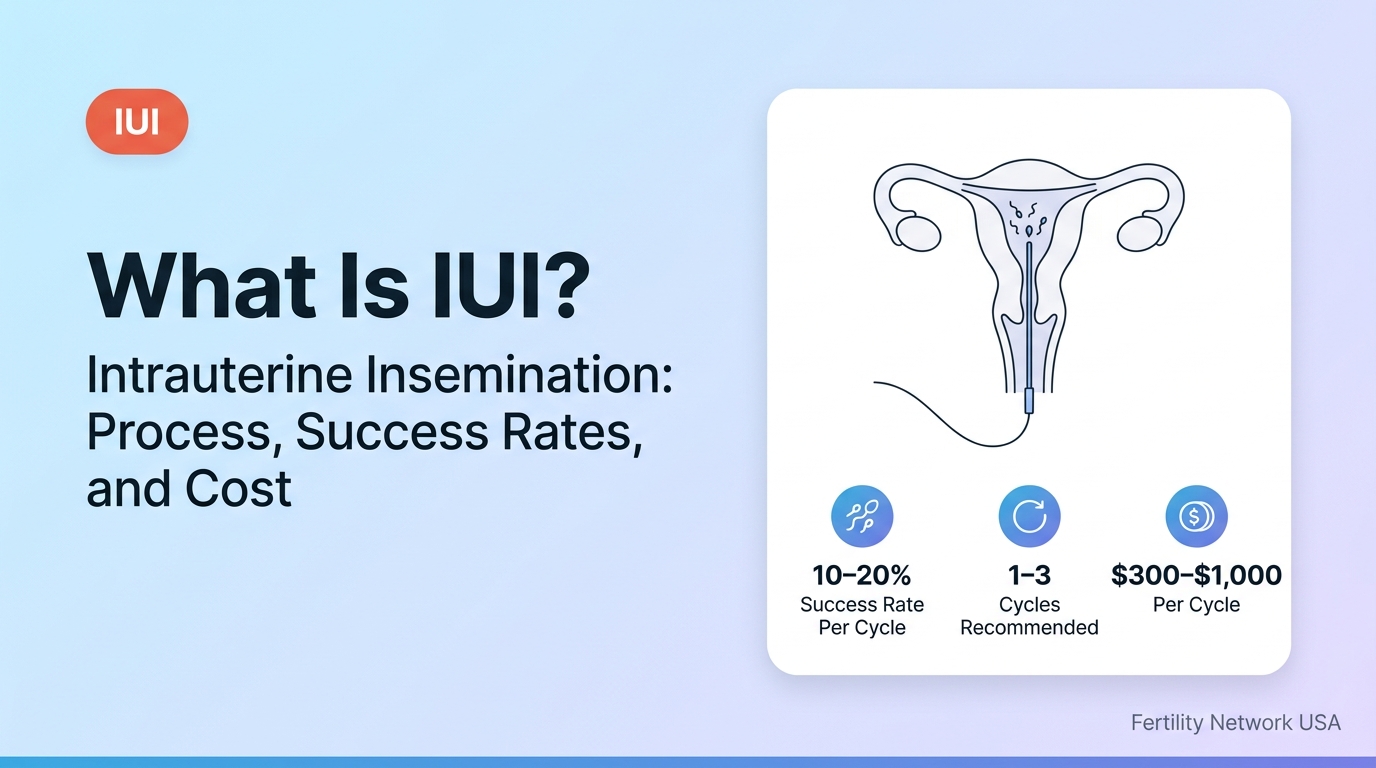
What is IUI (intrauterine insemination)?
IUI (intrauterine insemination) is a fertility procedure in which washed and concentrated sperm is placed directly into the uterine cavity using a thin catheter passed through the cervix at the time of ovulation. By depositing sperm past the cervix and closer to the fallopian tubes, IUI increases the number of sperm available to fertilize the egg at the moment of ovulation.
IUI is not classified as ART (assisted reproductive technology) by the CDC because it handles only sperm — not eggs or embryos — outside the body. This distinction means IUI is not subject to FCSRCA reporting requirements and is not included in the CDC NASS Annual Report. IUI is instead classified as a fertility treatment and is governed by ASRM (American Society for Reproductive Medicine) clinical practice guidelines.
How does an IUI procedure work?
An IUI procedure involves 5 steps: ovulation timing or induction, sperm collection and washing, catheter insertion, sperm deposition, and post-procedure observation. The entire insemination procedure takes 10–15 minutes and requires no anesthesia.
Ovulation timing or induction
In a natural cycle IUI, ovulation is tracked using urine LH (luteinizing hormone) test strips or blood tests. IUI is performed 24–36 hours after the LH surge is detected, coinciding with the natural ovulation window. In a stimulated IUI, ovulation induction medications — clomiphene citrate (Clomid), letrozole (Femara), or low-dose injectable gonadotropins — are used to develop 1–3 dominant follicles. An hCG trigger injection (Ovidrel 250 mcg) or GnRH agonist trigger is then given to schedule ovulation precisely, with IUI performed 36 hours later.
Sperm collection and washing
The male partner produces a semen sample by masturbation at the clinic 1–2 hours before the scheduled IUI. Donor sperm samples are thawed from cryopreserved vials on the same timeline. The sample undergoes sperm washing — either density gradient centrifugation or swim-up technique — to separate motile sperm from seminal plasma, dead sperm, debris, and prostaglandins. Removing seminal plasma is essential because it causes uterine cramping if injected directly into the uterus.
Total motile sperm count (TMSC) assessment
After washing, the andrologist calculates the total motile sperm count (TMSC) — the total number of motile sperm in the washed sample. A TMSC of 5 million or more is required for IUI to be clinically appropriate; TMSC below 5 million significantly reduces IUI success probability and indicates referral to IVF with ICSI. The optimal TMSC for IUI is 20–40 million motile sperm per insemination.
Catheter insertion and sperm deposition
The patient lies on the examination table and the reproductive endocrinologist or nurse inserts a speculum to visualize the cervix. A thin, flexible IUI catheter is guided through the cervical opening into the uterine cavity. The washed sperm sample (0.3–0.5 mL) is slowly injected through the catheter over 30–60 seconds. Most patients experience mild cramping during catheter passage; the procedure takes 10–15 minutes total.
Post-procedure rest and follow-up
Patients rest for 10–15 minutes after the procedure and resume normal activities immediately. Progesterone suppositories or injections are prescribed in some stimulated IUI protocols to support the luteal phase. A pregnancy blood test (beta-hCG) is performed 14 days after the IUI to confirm or rule out implantation.
What is the IUI success rate per cycle?
The IUI success rate per cycle ranges from 5–10% for natural cycle IUI to 15–20% for stimulated IUI in women under 40 with a good diagnosis, according to ASRM Practice Committee published data. Stimulated IUI — using clomiphene or letrozole with an hCG trigger — consistently outperforms natural cycle IUI by increasing the number of mature follicles available for fertilization from 1 to 2–3.
| IUI Type & Patient Profile | Success Rate Per Cycle | Cumulative Rate (3 cycles) |
|---|---|---|
| Natural cycle IUI — unexplained infertility, under 35 | 5 – 10% | 15 – 28% |
| Stimulated IUI (clomiphene/letrozole) — unexplained, under 35 | 12 – 18% | 34 – 47% |
| Stimulated IUI (injectable gonadotropins) — unexplained, under 35 | 15 – 25% | 40 – 58% |
| Stimulated IUI — mild male factor (TMSC 5–15M), under 35 | 10 – 15% | 28 – 40% |
| Stimulated IUI — donor sperm, under 35 | 15 – 20% | 40 – 55% |
| Stimulated IUI — unexplained infertility, age 38–40 | 8 – 12% | 22 – 32% |
| Stimulated IUI — any indication, over 40 | 2 – 5% | 6 – 15% |
Who is IUI recommended for?
IUI is recommended for 4 patient groups: unexplained infertility, mild male factor infertility, cervical factor infertility, and patients using donor sperm — including same-sex female couples and single women. IUI is not appropriate for patients with bilateral tubal occlusion, severe male factor infertility (TMSC below 5 million after washing), or diminished ovarian reserve where IVF produces significantly better outcomes.
| Diagnosis | IUI Appropriate? | Why | If IUI Fails |
|---|---|---|---|
| Unexplained infertility | Yes — first-line | No structural barrier; IUI improves sperm delivery | IVF after 3–6 failed IUI cycles |
| Mild male factor (TMSC 5–15M) | Yes — appropriate | Washed TMSC above 5M threshold; IUI deposits more sperm near egg | IVF with ICSI after 3–4 failed IUI cycles |
| Donor sperm (single women, same-sex couples) | Yes — first-line | Donor sperm TMSC consistently high; IUI most cost-effective first step | IVF if IUI fails after 3–6 cycles |
| Cervical factor | Yes — bypasses cervix | IUI deposits sperm past hostile cervical mucus directly into uterus | IVF if 3–4 IUI cycles fail |
| Severe male factor (TMSC below 5M) | No — IVF/ICSI indicated | Insufficient motile sperm for IUI to be effective | Proceed directly to IVF with ICSI |
| Bilateral tubal occlusion | No — IVF only | Fallopian tubes blocked; sperm cannot reach egg regardless of IUI | IVF only — IUI cannot overcome tubal blockage |
| Diminished ovarian reserve | Rarely — poor prognosis | Low AMH = fewer follicles; IVF produces more embryos per cycle | Transition to IVF promptly |
What is the difference between IUI and IVF?
IUI places washed sperm into the uterus and allows natural fertilization to occur in the fallopian tube; IVF retrieves eggs from the ovaries and fertilizes them with sperm in a laboratory. IUI costs $300–$1,000 per cycle; IVF costs $12,000–$15,000 per cycle. The IUI live birth rate is 10–20% per stimulated cycle; the IVF live birth rate is 49.7% per retrieval for women under 35 (CDC NASS 2022).
| Factor | IUI | IVF |
|---|---|---|
| Fertilization location | Fallopian tube (inside body) | Laboratory dish (outside body) |
| Egg retrieval required? | No | Yes — surgical retrieval under sedation |
| Classified as ART by CDC? | No | Yes |
| Cost per cycle | $300 – $1,000 (procedure only) | $12,000 – $15,000 (base cycle) |
| Live birth rate per cycle (under 35) | 10 – 20% (stimulated) | 49.7% (CDC NASS 2022) |
| Procedure duration | 10 – 15 minutes; no sedation | Retrieval: 15–20 min under IV sedation; Transfer: 5–10 min; no sedation |
| Medications required | Optional (natural or stimulated); oral meds $10–$80 or injectables $500–$2,000 | Required; injectable gonadotropins $3,000–$6,000 |
| PGT-A embryo testing possible? | No — no embryo created in lab | Yes — embryos biopsied at blastocyst stage |
| Tubal blockage — still effective? | No | Yes — bypasses fallopian tubes entirely |
For a detailed comparative guide, see IVF vs IUI: Success Rates, Cost Difference, and When to Choose Each.
How much does IUI cost in the United States?
IUI costs $300 to $1,000 per cycle for the insemination procedure alone, making it significantly cheaper than IVF per cycle. Stimulated IUI — adding ovulation induction medications and monitoring ultrasounds — raises the total per-cycle cost to $1,500 to $4,000 depending on the medication protocol.
| IUI Cost Component | Average Cost | Notes |
|---|---|---|
| IUI insemination procedure | $300 – $1,000 | Includes sperm washing and insemination; varies by clinic |
| Monitoring ultrasound (per visit) | $150 – $400 | 1–3 monitoring visits per cycle for stimulated IUI |
| Bloodwork (estradiol, LH levels) | $50 – $150 per draw | 1–3 blood draws per stimulated cycle |
| Clomiphene citrate (Clomid) | $10 – $50 per cycle | Oral medication; days 3–7 or 5–9 of cycle |
| Letrozole (Femara) | $20 – $80 per cycle | Preferred over clomiphene for PCOS; lower multiple risk |
| Injectable gonadotropins | $500 – $2,000 per cycle | Higher egg yield; higher multiple pregnancy risk |
| hCG trigger injection (Ovidrel) | $80 – $200 | Triggers ovulation; times IUI precisely 36 hours later |
| Donor sperm vial (if applicable) | $700 – $1,200 per vial | Cost from ASRM-accredited sperm bank; 1–2 vials per IUI |
| Natural cycle IUI — total | $400 – $1,200 | Procedure + monitoring only; no stimulation medications |
| Stimulated IUI (clomiphene/letrozole) — total | $800 – $2,000 | Procedure + oral medications + 2–3 monitoring visits |
| Stimulated IUI (injectables) — total | $1,500 – $4,000 | Procedure + gonadotropins + trigger + 3–4 monitoring visits |
IUI is covered by health insurance in most US states that have fertility insurance mandates, including New York, Massachusetts, Illinois, and New Jersey. IUI coverage is often less restrictive than IVF coverage — many plans that do not cover IVF still cover IUI and diagnostic testing. Verify coverage with your insurer before the first cycle.
How many IUI cycles should a patient attempt before switching to IVF?
ASRM recommends attempting 3–6 IUI cycles before proceeding to IVF for most diagnoses in women under 38, as cumulative IUI success rates plateau after 6 cycles and additional IUI beyond that point is unlikely to improve outcomes (ASRM Practice Committee, 2023).
The optimal number of IUI cycles before IVF depends on 3 factors: patient age, primary diagnosis, and ovarian reserve. Women over 38 should consider transitioning to IVF after 1–3 IUI cycles, as age-related egg quality decline makes each additional IUI cycle less productive and each month of delay more costly in terms of egg reserve. Patients with diminished ovarian reserve (AMH below 1.0 ng/mL) should have an explicit IVF transition discussion with their reproductive endocrinologist after the first failed IUI cycle.
| Patient Profile | Recommended IUI Cycles | Rationale |
|---|---|---|
| Unexplained infertility, under 35, normal reserve | 3 – 6 cycles | ASRM guideline; cumulative rate reaches 40–58% by cycle 6 |
| Unexplained infertility, age 35–37, normal reserve | 3 – 4 cycles | Age shortens optimal IUI window; transition sooner |
| Unexplained infertility, age 38–40 | 1 – 3 cycles | Declining egg quality; IVF more efficient per month |
| Over 40 | Consider IVF first | IUI success rate below 5% per cycle; IVF preferred |
| Mild male factor (TMSC 5–15M) | 3 – 4 cycles | IUI effective with adequate TMSC; IVF/ICSI after failure |
| Donor sperm, under 35 | 3 – 6 cycles | High-quality donor sperm; IUI cumulative rates comparable to IVF per $ spent |
| Diminished ovarian reserve (AMH below 1.0) | 1 – 2 cycles maximum | Low reserve = poor IUI prognosis; IVF preserves more eggs per cycle |
Frequently Asked Questions
Is IUI painful?+
IUI causes mild-to-moderate cramping in most patients during catheter passage through the cervix, lasting 30–60 seconds. The procedure itself takes 10–15 minutes and requires no anesthesia or sedation. Patients with cervical stenosis (narrowing) may experience more significant discomfort during catheter insertion. Post-procedure cramping lasting 1–4 hours is common and manageable with over-the-counter ibuprofen (400–600 mg) taken 1 hour before the procedure.
Can IUI cause twins?+
Stimulated IUI with injectable gonadotropins carries a 15–25% twin pregnancy risk if 2 or more dominant follicles develop. Natural cycle IUI and oral medication (clomiphene/letrozole) IUI have lower twin rates of 5–10% and 7–12% respectively. ASRM recommends cancelling a stimulated IUI cycle and converting to timed intercourse or IVF with single embryo transfer (SET) if 3 or more follicles reach 14mm or larger on monitoring ultrasound. IVF with SET eliminates the multiple pregnancy risk associated with stimulated IUI.
What is the difference between IUI with clomiphene and letrozole?+
Letrozole (Femara) is preferred over clomiphene citrate (Clomid) for IUI stimulation in most patients, particularly those with PCOS, because it produces a lower multiple pregnancy rate and a more favorable uterine environment. Clomiphene is a selective estrogen receptor modulator (SERM) that thins the endometrial lining and thickens cervical mucus as side effects — both of which can reduce IUI effectiveness. Letrozole is an aromatase inhibitor that does not have these endometrial or cervical effects. Letrozole produces 1–2 dominant follicles per cycle in most patients (vs. 1–3 with clomiphene) and achieves equivalent or higher pregnancy rates with a lower multiple gestation risk.
Can IUI be done with frozen sperm?+
IUI can be performed with frozen sperm — including previously cryopreserved partner sperm and donor sperm from an ASRM-accredited sperm bank. Frozen sperm samples are thawed and washed on the day of the IUI procedure in the same manner as fresh samples. Post-thaw TMSC is typically 30–50% lower than pre-freeze TMSC due to cryopreservation-related motility loss. Donor sperm banks guarantee a minimum post-thaw TMSC (typically 10–20 million motile sperm per vial) that is sufficient for IUI. Partner sperm frozen before chemotherapy or surgery should be assessed for post-thaw TMSC before IUI planning.
Does IUI increase the risk of ectopic pregnancy?+
IUI carries an ectopic pregnancy risk of approximately 1–2% per successful conception — similar to the natural ectopic rate in the general population. IUI does not increase ectopic risk above baseline because sperm are deposited into the uterine cavity, not the fallopian tube; fertilization still occurs naturally in the fallopian tube. Patients with prior tubal surgery, pelvic inflammatory disease (PID), or known tubal abnormalities have a higher baseline ectopic risk regardless of the fertility treatment used.
Fertility Network USA is an independent information directory. All IUI success rates in this article are sourced from ASRM Practice Committee published guidelines and peer-reviewed reproductive medicine literature. IVF success rates are sourced from the CDC NASS 2022 Annual Report. IUI is not reported to the CDC and therefore not included in NASS data. Individual IUI outcomes vary significantly by diagnosis, age, ovarian reserve, sperm parameters, and stimulation protocol. This article does not constitute medical advice. Always consult a board-certified reproductive endocrinologist before beginning fertility treatment.