What is the main difference between IVF and IUI?
IVF (in vitro fertilization) retrieves eggs from the ovaries, fertilizes them with sperm in a laboratory, and transfers the resulting embryo into the uterus; IUI (intrauterine insemination) places washed sperm directly into the uterine cavity and allows natural fertilization to occur inside the fallopian tube. IVF handles eggs and embryos outside the body and is classified as ART (assisted reproductive technology) by the CDC. IUI handles only sperm and is not classified as ART.
The practical consequence of this difference is significant: IVF gives the embryologist full control over fertilization, embryo quality selection, PGT-A genetic testing, and the number and timing of embryo transfers. IUI relies entirely on natural sperm-egg interaction in the fallopian tube — it increases the number of sperm available at the right location and time, but cannot control fertilization outcome, embryo quality, or chromosomal status.
Which has the higher success rate — IVF or IUI?
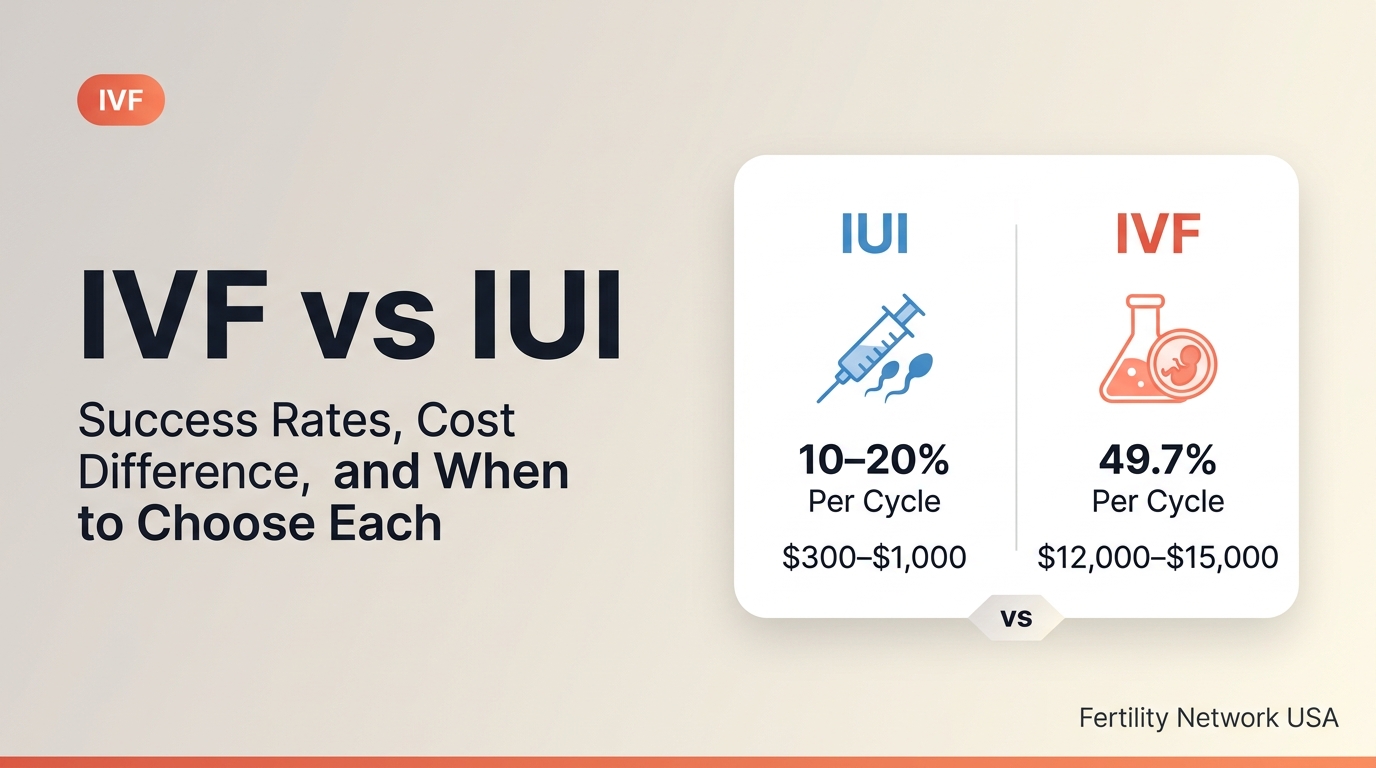
IVF has a significantly higher per-cycle live birth rate than IUI at every age group: 49.7% vs 10–20% for women under 35, and 11.6% vs 2–5% for women over 40 (CDC NASS 2022; ASRM 2023). The IVF advantage increases with age because IVF with PGT-A can select euploid embryos — eliminating the chromosomally abnormal embryos that cause most IUI failures and miscarriages in older patients.
| Patient Age | IVF Live Birth Rate / Retrieval (Own Egg) | Stimulated IUI Live Birth Rate / Cycle | IVF Advantage |
|---|---|---|---|
| Under 35 | 49.7% | 12 – 20% | +30 – 38 percentage points |
| Age 35–37 | 35.4% | 10 – 15% | +20 – 25 percentage points |
| Age 38–40 | 23.1% | 6 – 10% | +13 – 17 percentage points |
| Age 41–42 | 11.6% | 3 – 6% | +6 – 9 percentage points |
| Over 42 | 4.3% | 1 – 3% | +1 – 3 percentage points (minimal own-egg advantage) |
How much cheaper is IUI compared to IVF?
IUI costs $300–$1,000 per cycle for the procedure alone — approximately 90–96% less than the IVF base cycle cost of $12,000–$15,000. A complete stimulated IUI cycle with oral medications and monitoring costs $800–$2,000; a complete stimulated IUI with injectable gonadotropins costs $1,500–$4,000. A complete IVF cycle with injectable medications costs $15,000–$22,500.
| Treatment | Procedure Cost | Medications | Total Per Cycle |
|---|---|---|---|
| Natural cycle IUI | $300 – $1,000 | None | $400 – $1,200 |
| Stimulated IUI (clomiphene / letrozole) | $300 – $1,000 | $30 – $200 (oral) | $800 – $2,000 |
| Stimulated IUI (injectable gonadotropins) | $300 – $1,000 | $500 – $2,000 | $1,500 – $4,000 |
| IVF base cycle (fresh transfer) | $12,000 – $15,000 | $3,000 – $6,000 | $15,000 – $22,500 |
| IVF with ICSI + PGT-A + FET | $12,000 – $15,000 | $3,000 – $6,000 + $4,000–$8,000 PGT-A + $3,000–$5,000 FET | $22,000 – $34,000 |
What are the key differences between IVF and IUI across all factors?
IVF and IUI differ across 12 clinically significant factors — including fertilization method, ART classification, success rates, cost, required procedures, multiple pregnancy risk, tubal requirement, and genetic testing capability. Understanding all 12 differences is essential for choosing the right treatment at the right time.
| Factor | IUI | IVF |
|---|---|---|
| Fertilization location | Fallopian tube (natural, inside body) | Laboratory dish (outside body) |
| Classified as ART by CDC? | No — only sperm handled outside body | Yes — eggs and embryos handled outside body |
| Egg retrieval required? | No | Yes — surgical retrieval under IV sedation |
| Live birth rate / cycle (under 35) | 10 – 20% (stimulated) | 49.7% (CDC NASS 2022) |
| Procedure cost | $300 – $1,000 | $12,000 – $15,000 (base) |
| Total cycle cost | $400 – $4,000 | $15,000 – $34,000 |
| Minimum sperm needed | 5 million TMSC (washed) | 1 sperm per egg (with ICSI) |
| Fallopian tubes must be open? | Yes — both tubes must be patent | No — bypasses fallopian tubes entirely |
| Embryo genetic testing (PGT-A) | No — no embryo created in lab | Yes — embryos biopsied at day 5–6 |
| Multiple pregnancy risk | 15–25% twin risk with injectable stimulation | Less than 2% twin risk with single embryo transfer (SET) |
| Anesthesia required? | No — outpatient procedure; no sedation | Yes — IV sedation for egg retrieval |
| ASRM-recommended cycles before escalation | 3–6 IUI cycles (under 38) | No upper limit — cycle until euploid embryo bank achieved |
When should a patient choose IUI before IVF?
A patient should choose IUI before IVF when 4 conditions are met: both fallopian tubes are patent, total motile sperm count (TMSC) after washing is above 5 million, the patient is under 38, and the diagnosis is unexplained infertility, mild male factor, cervical factor, or donor sperm use. Under these conditions, the cumulative IUI success rate over 3–6 cycles justifies the lower cost before escalating to IVF.
| Scenario | Start with IUI? | ASRM Recommended IUI Cycles |
|---|---|---|
| Unexplained infertility — under 35, normal reserve, both tubes open | Yes | 3 – 6 cycles |
| Mild male factor — TMSC 5–15M after wash, normal female evaluation | Yes | 3 – 4 cycles |
| Donor sperm — single woman or same-sex female couple, under 38 | Yes | 3 – 6 cycles |
| Cervical factor — hostile mucus, normal sperm, open tubes | Yes | 3 – 4 cycles |
| Unexplained infertility — age 35–37, normal reserve | Yes — but limit cycles | 3 – 4 cycles max before escalating |
When should a patient skip IUI and go directly to IVF?
A patient should skip IUI and proceed directly to IVF when any of the following are present: bilateral tubal occlusion, severe male factor infertility (TMSC below 5 million), azoospermia, age over 40, AMH below 0.5 ng/mL, or 3+ prior failed IUI cycles. In these situations, IUI either cannot succeed due to a structural or biological barrier, or its per-cycle success rate is too low to justify the time cost of additional IUI attempts before IVF.
| Finding | Skip IUI? | Reason IUI Cannot Succeed |
|---|---|---|
| Bilateral tubal occlusion | Yes — IVF only | Both tubes blocked; sperm cannot reach egg regardless of IUI placement |
| Azoospermia (no sperm in ejaculate) | Yes — IVF + ICSI with surgical sperm | No sperm for IUI; TESA/TESE/MESA + ICSI required |
| Severe male factor — TMSC below 5M after wash | Yes — IVF + ICSI | Insufficient motile sperm for IUI to be effective |
| Age over 40 | Yes — IVF preferred | IUI success rate falls below 3–5% per cycle; IVF + PGT-A far more efficient |
| AMH below 0.5 ng/mL (severely diminished reserve) | Yes — IVF preferred | Very low egg reserve; each month of delay reduces future IVF options |
| Prior ectopic pregnancy with one tube removed | Discuss with REI | One open tube may still allow IUI; success rate reduced; IVF eliminates tubal risk |
| 3+ prior failed IUI cycles (same diagnosis, no new findings) | Yes — escalate to IVF | ASRM: cumulative IUI benefit plateaus after 3–6 cycles; IVF more efficient going forward |
| Endometriosis (moderate to severe) | Usually yes | Moderate–severe endometriosis reduces IUI success significantly; IVF preferred per ASRM |
How does the IVF vs IUI decision differ by fertility diagnosis?
The optimal choice between IVF and IUI is determined primarily by the fertility diagnosis — not by patient preference or cost alone. 5 diagnoses have clear clinical guidelines directing the choice; 2 diagnoses require individualized decision-making with the reproductive endocrinologist.
| Diagnosis | Recommended First Step | Rationale |
|---|---|---|
| Unexplained infertility (under 38) | IUI (3–6 cycles) | No structural barrier; IUI is cost-effective first step per ASRM |
| Bilateral tubal occlusion | IVF only | IUI cannot bypass blocked tubes; fertilization impossible without open tube |
| Severe male factor / azoospermia | IVF + ICSI | TMSC below 5M makes IUI ineffective; ICSI requires lab fertilization |
| Mild male factor (TMSC 5–15M) | IUI (3–4 cycles) | Adequate motile sperm for IUI; ASRM supports IUI as first step |
| PCOS (polycystic ovary syndrome) | IUI with letrozole (3–6 cycles) | PCOS responds well to ovulation induction; IUI is cost-effective if sperm normal |
| Diminished ovarian reserve (AMH below 1.0) | IVF — sooner rather than later | Declining reserve makes IUI less efficient per month; IVF banks embryos before further decline |
| Moderate–severe endometriosis | IVF preferred | Distorted tubal anatomy and inflammatory environment reduce IUI success; IVF bypasses |
| Recurrent pregnancy loss (RPL) | IVF + PGT-A | 50–60% of RPL caused by embryo aneuploidy; only IVF can test embryos before transfer |
How do cumulative live birth rates compare over multiple cycles of IVF vs IUI?
After 3 cycles, cumulative IVF live birth rates (65–80% for women under 35) significantly exceed cumulative IUI rates (34–47%) — but cumulative IUI over 6 cycles reaches 50–60% at a fraction of the cost of 3 IVF cycles. The comparison shifts at age 38+, where IUI cumulative rates drop sharply and IVF's per-cycle advantage increases.
| Number of Cycles | Cumulative IVF Live Birth Rate (Under 35) | Cumulative Stimulated IUI Rate (Under 35) | Approximate Total IVF Cost | Approximate Total IUI Cost |
|---|---|---|---|---|
| 1 cycle | 49.7% | 12 – 20% | $15,000 – $22,500 | $800 – $4,000 |
| 2 cycles | 65 – 72% | 22 – 36% | $30,000 – $45,000 | $1,600 – $8,000 |
| 3 cycles | 70 – 80% | 34 – 47% | $45,000 – $67,500 | $2,400 – $12,000 |
| 6 cycles | 80 – 88% (diminishing returns) | 55 – 70% | $90,000 – $135,000 | $4,800 – $24,000 |
For patients under 35 with unexplained infertility and normal sperm, 6 cycles of stimulated IUI achieve 55–70% cumulative live birth rate at $4,800–$24,000 total — versus 80–88% after 6 IVF cycles at $90,000+. The IUI strategy produces a meaningful live birth probability at dramatically lower cost if success comes in the first 3–4 cycles. The strategy fails if 6 IUI cycles are unsuccessful and the patient must then begin IVF, having spent $12,000–$24,000 on IUI and additional months during which ovarian reserve has declined.
What is the cost per live birth for IVF versus IUI?
The cost per live birth for IVF is $30,000–$44,000 for women under 35 based on CDC NASS 2022 success rates; the cost per live birth for stimulated IUI is $8,000–$32,000 for the same age group over 3–6 cycles. IUI has a lower cost per live birth when it succeeds within 3 cycles. IVF has a lower cost per live birth when IUI requires more than 4–5 cycles before success.
| Treatment | Age Group | Live Birth Rate / Cycle | Cycles to 70% Cumulative Rate | Estimated Cost to 70% Probability |
|---|---|---|---|---|
| Stimulated IUI (injectables) | Under 35 | 15 – 20% | 5 – 6 IUI cycles | $7,500 – $24,000 |
| IVF (own egg, base cycle) | Under 35 | 49.7% | 1 – 2 IVF cycles | $15,000 – $45,000 |
| Stimulated IUI (injectables) | Age 38–40 | 6 – 10% | 8 – 10+ IUI cycles (rarely achieved) | $12,000 – $40,000+ |
| IVF (own egg, base cycle) | Age 38–40 | 23.1% | 3 – 4 IVF cycles | $45,000 – $90,000 |
| IVF + PGT-A (euploid transfer) | Age 38–40 | 55 – 65% per euploid transfer | 1 – 2 transfers if euploid embryo available | $22,000 – $40,000 (if euploid found) |
Frequently Asked Questions
Can a patient do IUI and IVF in the same month?+
IUI and IVF cannot be performed in the same menstrual cycle because they require incompatible ovarian stimulation protocols. IUI uses mild-to-moderate ovarian stimulation targeting 1–3 dominant follicles. IVF uses full gonadotropin stimulation targeting 10–15 follicles for egg retrieval. A failed IUI cycle can be followed immediately by an IVF stimulation cycle in the next menstrual period without a gap, subject to the clinician's assessment of ovarian recovery from the prior stimulation.
Does IUI work for same-sex female couples?+
IUI with donor sperm is the most common first-line fertility treatment for same-sex female couples with no identified fertility diagnosis, achieving a 15–20% live birth rate per stimulated cycle for women under 35. ASRM recommends 3–6 IUI cycles before moving to IVF for same-sex female couples with normal fallopian tubes and no identified infertility diagnosis. Reciprocal IVF — in which one partner's eggs are fertilized and transferred into the other partner's uterus — is an IVF-based alternative for couples who want both partners to be biologically involved in the pregnancy. Reciprocal IVF costs $20,000–$30,000 including donor sperm and is not appropriate as a first step for most couples.
Does insurance cover IUI and IVF equally?+
IUI is more broadly covered by health insurance than IVF — many plans that do not cover IVF still cover IUI when medically indicated. In the 21 US states plus DC with fertility insurance mandates, IUI coverage is typically less restricted than IVF coverage in terms of cycle limits and diagnosis requirements. In states without mandates, IUI is often covered as a less-invasive fertility treatment even when IVF is explicitly excluded. Verify your specific plan's coverage with your insurer before beginning either treatment. For the full state-by-state insurance mandate guide, see IVF Cost in the USA: Average Price Per Cycle, by State, and Hidden Fees.
Can a failed IVF cycle be followed by IUI?+
Switching from IVF back to IUI after a failed IVF cycle is not recommended unless the IVF failure reveals that IVF is no longer appropriate and a simpler approach is warranted. IVF is the more effective treatment — a failed IVF cycle indicates a need to investigate the cause of failure (embryo quality, uterine factors, sperm DNA fragmentation) and optimize the next IVF attempt, not to downgrade to IUI. The only scenario in which reverting to IUI after IVF makes clinical sense is if the IVF evaluation reveals that the original IUI indication (mild male factor, unexplained infertility with good prognosis) was the correct diagnosis and frozen embryos remain available for transfer.
What is the difference between IUI and timed intercourse?+
Timed intercourse (TI) schedules sexual intercourse to coincide with the ovulation window detected by LH surge testing or ultrasound monitoring; IUI replaces intercourse with direct uterine sperm deposition using a catheter. Timed intercourse costs $0–$300 per cycle (monitoring only) and achieves 3–8% live birth rate per cycle for unexplained infertility. IUI adds sperm washing and catheter deposition but achieves 10–20% per stimulated cycle — roughly 2–3× the rate of timed intercourse — because it places a higher concentration of motile sperm directly past the cervix into the uterine cavity. ASRM recommends IUI over timed intercourse as the treatment escalation step before IVF.
Fertility Network USA is an independent information directory. All IVF live birth rates are sourced from the CDC National ART Surveillance System (NASS) 2022 Annual Report. IUI success rates are sourced from ASRM Practice Committee published guidelines (2023). IUI is not reported to the CDC and is not included in NASS data. Cost data reflects 2024 US national averages from RESOLVE and FertilityIQ. Individual outcomes vary significantly by clinic, diagnosis, age, and treatment protocol. This article does not constitute medical advice. Always consult a board-certified reproductive endocrinologist before choosing between IVF and IUI.