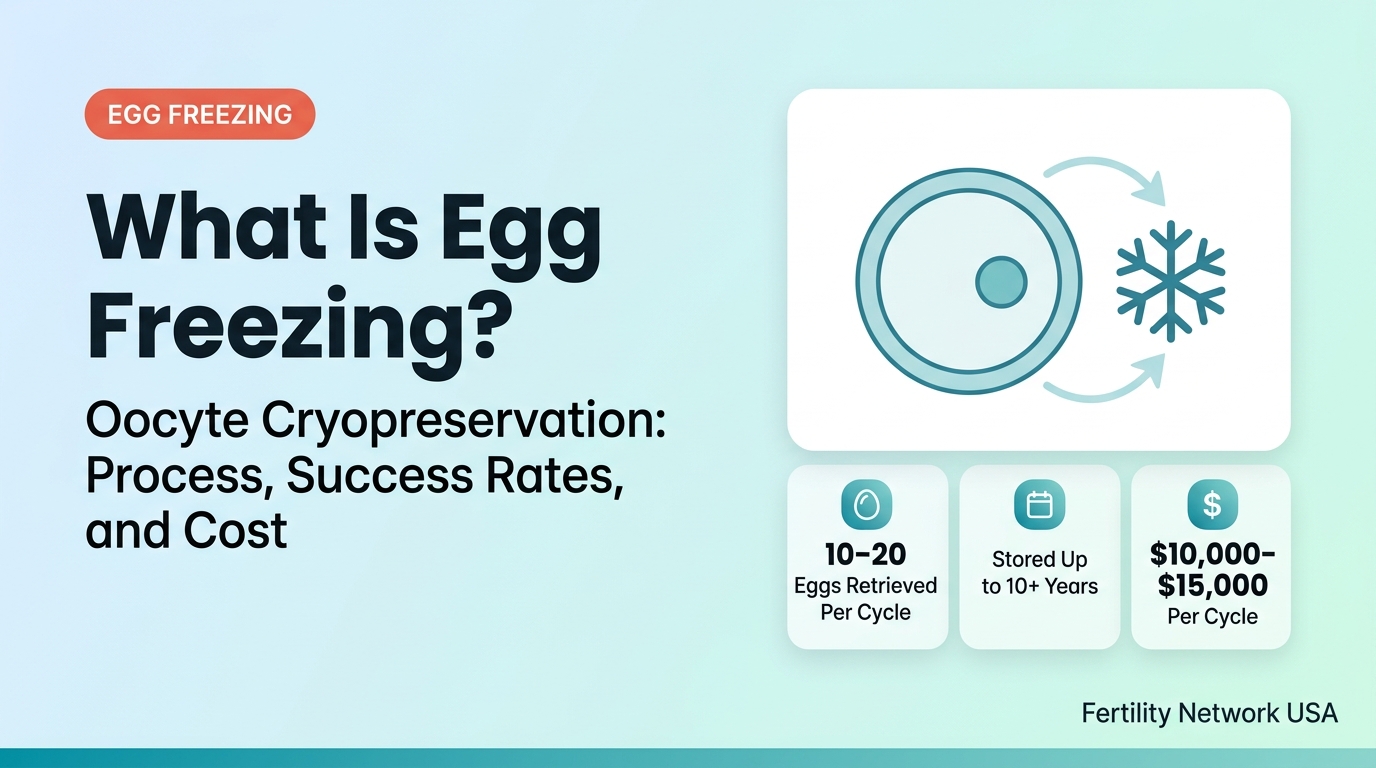
What is egg freezing?
Egg freezing (oocyte cryopreservation) is a fertility preservation procedure in which mature eggs (MII oocytes) are retrieved from the ovaries, vitrified (flash-frozen) in liquid nitrogen at -196°C, and stored for future fertilization and use in an IVF cycle. The egg freezing process uses the same ovarian stimulation and egg retrieval steps as IVF — the only difference is that retrieved eggs are frozen immediately rather than fertilized in the laboratory.
The CDC classifies egg freezing as a banking cycle within the ART (assisted reproductive technology) category because it handles eggs outside the body. Banking cycles — performed for future fertility preservation rather than immediate pregnancy — accounted for approximately 22% of all 326,468 ART cycles reported in the United States in 2022 (CDC NASS 2022).
Egg freezing is performed for 2 primary indications: elective fertility preservation (preserving eggs before natural age-related decline for patients who are not yet ready to conceive) and medical fertility preservation (preserving eggs before chemotherapy, radiation, or surgical procedures that risk ovarian damage — such as oophorectomy, ovarian cystectomy, or pelvic radiation for cancer treatment).
How does the egg freezing process work?
The egg freezing process involves 6 steps: baseline evaluation, ovarian stimulation, monitoring, egg retrieval, vitrification, and cryostorage — the same first 4 steps as IVF, with vitrification replacing fertilization.
Baseline evaluation
A reproductive endocrinologist performs a baseline transvaginal ultrasound to count antral follicles (AFC) and orders an AMH (anti-Müllerian hormone) blood test to assess ovarian reserve. AFC and AMH together predict the expected egg yield per stimulation cycle. A patient with AMH of 2.0 ng/mL and AFC of 14 can expect 10–15 mature eggs per retrieval cycle.
Ovarian stimulation (8–14 days)
Daily injectable gonadotropin medications — FSH products such as Gonal-F, Follistim, or Menopur — stimulate the ovaries to develop multiple follicles simultaneously. A GnRH antagonist (Ganirelix or Cetrotide) is added from approximately day 5 to prevent premature ovulation. The target is 10–15 mature folliclesmeasuring 17–20mm on ultrasound at the end of stimulation.
Monitoring (every 1–3 days during stimulation)
Transvaginal ultrasound and blood tests measuring estradiol and LH levels confirm follicle growth and guide medication dose adjustments. A trigger injection — hCG (Ovidrel) or GnRH agonist (Lupron) — is given when lead follicles reach 17–20mm to trigger final egg maturation. Egg retrieval is scheduled exactly 36 hours after the trigger injection.
Egg retrieval (15–20 minutes)
A reproductive endocrinologist uses a transvaginal ultrasound-guided needle to aspirate fluid from each follicle while the patient is under intravenous sedation. An embryologist immediately examines the aspirated fluid to identify and classify eggs as mature (MII), immature (MI or GV), or degenerated. Only mature MII eggs are vitrified — immature eggs cannot be frozen for standard egg banking.
Vitrification (flash-freezing)
Within 2 hours of retrieval, the embryologist loads mature eggs onto vitrification devices after exposing them to cryoprotectant solutions. The device is plunged directly into liquid nitrogen at -196°C, freezing the egg in under 1 second — fast enough to prevent ice crystal formation inside the cell, which is the primary cause of egg damage during freezing.
Cryostorage
Vitrified eggs are stored in liquid nitrogen tanks at -196°C. Biological activity halts completely at this temperature, meaning eggs stored for 1 year and eggs stored for 15 years have equivalent expected outcomes — storage duration does not reduce egg quality. Eggs remain in storage until the patient is ready to attempt pregnancy, at which point they are thawed, fertilized by ICSI, and cultured to blastocyst stage for embryo transfer.
What is vitrification and why does it replace slow-freeze?
Vitrification is an ultra-rapid egg freezing technique that cools eggs at 15,000–30,000°C per minute, preventing intracellular ice crystal formation that damaged eggs frozen by the older slow-freeze method. The word "vitrification" derives from the Latin "vitreum" (glass) — vitrification converts the egg's intracellular water into a glass-like amorphous solid rather than ice crystals.
| Method | Cooling Rate | Thaw Survival Rate | Status |
|---|---|---|---|
| Vitrification (flash-freeze) | 15,000–30,000°C/min | 77–90% | Current standard — used at all major US fertility clinics |
| Slow-freeze (controlled-rate) | 0.3–1°C/min | 50–65% | Obsolete — replaced by vitrification post-2012 |
The shift from slow-freeze to vitrification was the technological breakthrough that transformed egg freezing from an experimental procedure into a clinically reliable one. Before vitrification, slow-freeze egg survival rates of 50–65% made cumulative live birth rates per frozen egg too low for routine clinical use. Vitrification's 77–90% survival rate made egg freezing outcomes comparable to embryo freezing (which had always been more efficient due to the embryo's more complex cellular structure being more tolerant of freezing).
What is the success rate of frozen eggs?
The live birth rate per thawed egg is approximately 5–12% for eggs frozen before age 35 and 2–4% per thawed egg for eggs frozen after age 38, according to ASRM published outcome data. This per-egg rate compounds across multiple eggs — meaning 10 thawed eggs frozen before 35 produce a cumulative live birth probability of 40–65% per thaw cycle.
Egg freezing success follows a 4-stage attrition funnel: thaw survival → fertilization by ICSI → blastocyst development → successful implantation and live birth. At each stage, a proportion of eggs are lost.
| Stage | Rate (eggs frozen before 35) | Rate (eggs frozen age 38–40) |
|---|---|---|
| Thaw survival (vitrified eggs) | 80–90% | 77–85% |
| Fertilization by ICSI (of surviving eggs) | 70–80% | 65–75% |
| Blastocyst development (of fertilized eggs) | 50–65% | 40–55% |
| Live birth per blastocyst transferred | 40–55% | 25–35% |
| Live birth per thawed egg (cumulative) | 5–12% | 2–5% |
At what age should a woman freeze her eggs?
Freezing eggs before age 35 maximizes live birth probability per egg stored, because egg quality and quantity are highest before 35 and decline progressively thereafter. ASRM data shows a clinically significant drop in per-egg live birth probability beginning at age 37 — from 5–12% per egg frozen before 35 to 2–4% per egg frozen at 38–40.
| Age at Egg Freezing | Live Birth Rate Per Thawed Egg | Eggs Needed for 70% Cumulative Live Birth Chance | Prognosis |
|---|---|---|---|
| Under 35 | 5 – 12% | 10 – 15 mature eggs | Excellent |
| Age 35–37 | 4 – 8% | 15 – 20 mature eggs | Good |
| Age 38–40 | 2 – 5% | 20 – 30 mature eggs | Fair — multiple cycles likely needed |
| Over 40 | 1 – 3% | 30+ mature eggs (may require 3–5 retrieval cycles) | Poor — discuss donor egg as alternative |
The optimal egg freezing window — balancing egg quality, ovarian reserve, and the likelihood of actually using the frozen eggs — is age 32 to 36, according to decision-analysis modeling published in Fertility and Sterility (Mesen et al., 2015; updated Chen et al., 2023). Freezing before 30 produces the highest per-egg success rates but also the highest chance that the eggs will never be used (since many women in their late 20s achieve spontaneous pregnancy before needing frozen eggs). Freezing after 37 requires more cycles and more eggs to achieve the same cumulative live birth probability.
How many eggs should be frozen for a good chance of live birth?
10 to 20 mature eggs frozen before age 35 gives a 70–80% cumulative live birth probability, according to ASRM oocyte cryopreservation outcome data. The exact number depends on the patient's age at freezing — older patients need more eggs to compensate for higher age-related aneuploidy rates.
| Mature Eggs Frozen | Cumulative Live Birth Probability (Under 35) | Cumulative Live Birth Probability (Age 38–40) |
|---|---|---|
| 5 mature eggs | 35 – 45% | 15 – 22% |
| 10 mature eggs | 55 – 65% | 25 – 40% |
| 15 mature eggs | 70 – 80% | 40 – 55% |
| 20 mature eggs | 80 – 90% | 55 – 70% |
| 25+ mature eggs | 85 – 95% | 65 – 80% |
A single stimulation cycle produces an average of 8–12 mature eggs for women under 35 with normal ovarian reserve. Patients with low ovarian reserve (AMH below 1.0 ng/mL) often require 2–3 retrieval cycles to accumulate 15–20 mature eggs. Most reproductive endocrinologists recommend completing egg banking in consecutive cycles — typically 2 cycles back-to-back with a 1-month recovery period between retrievals — to efficiently build an adequate egg bank before age-related decline accelerates.
How much does egg freezing cost in the United States?
Egg freezing costs $10,000 to $15,000 per cycle in the United States, including monitoring, egg retrieval, embryologist vitrification, and the first year of cryostorage. Gonadotropin medications add $3,000 to $6,000 per cycle, bringing the total out-of-pocket cost for one egg freezing cycle to $13,000 to $21,000.
| Egg Freezing Cost Component | Average Cost | Notes |
|---|---|---|
| Base egg freezing cycle (monitoring, retrieval, vitrification) | $10,000 – $15,000 | First year storage usually included |
| Gonadotropin medications (FSH, antagonist) | $3,000 – $6,000 | Billed separately by pharmacy; not included in base |
| Annual cryostorage (year 2 onward) | $500 – $1,000/year | Ongoing fee for each year of storage |
| Future thaw + ICSI fertilization + FET cycle | $5,000 – $8,000 | Cost when ready to use eggs; paid at time of use |
| Total: 1 cycle + medications + 5 years storage | $16,000 – $27,000 | Before the future thaw/FET cycle cost |
| Total: 2 cycles + medications + 5 years storage | $29,000 – $47,000 | For patients needing 2 retrievals to reach target egg count |
Many large US employers — including Google, Apple, Facebook, Amazon, and Goldman Sachs — now offer egg freezing as a fertility benefit through platforms such as Progyny, Maven Clinic, and WINFertility. Employer egg freezing benefits typically cover $10,000–$20,000 of the total cost. Egg freezing is also tax-deductible as a medical expense under IRS Publication 502, using FSA or HSA funds without the 7.5% AGI threshold requirement.
How long can frozen eggs be stored?
Frozen eggs can be stored indefinitely — biological aging stops completely at -196°C in liquid nitrogen. No upper time limit has been established by the FDA or ASRM for oocyte cryostorage. Published case reports document successful live births from eggs stored for 14–15 years, with no evidence of quality degradation related to storage duration alone.
The HFEA (Human Fertilisation and Embryology Authority) in the United Kingdom previously imposed a 10-year storage limit on frozen eggs, which was extended to 55 years in 2022 following updated scientific evidence that storage duration does not affect egg quality. The United States has no federally mandated storage time limit. Storage duration limits, if any, are set by individual clinic policy and vary by institution.
What is the difference between egg freezing and embryo freezing?
Egg freezing stores unfertilized eggs (oocytes); embryo freezing stores eggs already fertilized by sperm that have developed to blastocyst stage. Embryo freezing requires a sperm source — partner sperm or donor sperm — at the time of retrieval. Egg freezing does not require sperm at the time of freezing.
| Factor | Egg Freezing (Oocyte) | Embryo Freezing |
|---|---|---|
| Sperm required at time of freezing? | No | Yes — partner or donor sperm |
| What is frozen | Unfertilized MII oocyte | Day-5/6 blastocyst |
| Thaw survival rate | 77–90% | 90–95% |
| Success rate per thawed unit | 5–12% live birth per egg (under 35) | 40–55% live birth per blastocyst (under 35) |
| Flexibility if partner changes? | High — no partner committed | Low — embryo legally co-owned with sperm provider |
| Legal complexity of disposal | Patient decides alone | Both gamete providers must agree on embryo disposition |
| Best for | Single women; couples without committed partner; elective fertility preservation | Couples ready to create embryos; cancer patients with partner |
Embryo freezing produces a higher per-thawed-unit success rate than egg freezing because the blastocyst is a more complex, 100–200 cell structure that tolerates vitrification more robustly than a single oocyte. However, egg freezing preserves reproductive autonomy— the patient is not legally or ethically bound to a sperm provider at the time of freezing. For couples in a committed relationship who are certain they will use IVF together, embryo freezing is the more efficient option per dollar spent. For single women and those without a committed partner, egg freezing is the clinically appropriate choice.
Frequently Asked Questions
Does egg freezing affect future fertility?+
Egg freezing does not deplete future fertility or reduce the chances of natural conception after the procedure. The eggs retrieved during an egg freezing cycle are eggs that would naturally undergo atresia (programmed cell death) during that month's natural cycle — they are recruited by the gonadotropin medications from the cohort of follicles already destined to be reabsorbed. Ovarian reserve (as measured by AMH and AFC) typically returns to pre-stimulation levels within 1–2 months after egg retrieval (ASRM 2023).
Is egg freezing painful?+
The egg freezing stimulation phase causes bloating and pelvic discomfort in most patients; the egg retrieval procedure itself is performed under intravenous sedation and causes no pain during the procedure. Mild-to-moderate pelvic cramping and bloating for 1–5 days after retrieval is expected as the stimulated ovaries return to normal size. Severe abdominal pain, significant bloating, or rapid weight gain after retrieval may indicate ovarian hyperstimulation syndrome (OHSS) and requires immediate contact with the treating clinic.
Can egg freezing be covered by insurance?+
Egg freezing for medical indications (cancer, surgical risk to ovaries) is covered by some insurance plans; elective egg freezing for age-related fertility preservation is rarely covered by health insurance as of 2024. Several US states with fertility insurance mandates — including New York, Illinois, and New Jersey — require coverage of egg freezing when medically indicated (prior to cancer treatment). Elective egg freezing is typically not covered under state mandates, but may be covered through employer fertility benefits programs. FSA and HSA funds can be used for elective egg freezing without insurance approval.
What happens to frozen eggs if they are never used?+
Unused frozen eggs can be discarded, donated to another patient for reproductive use, or donated to scientific research— the patient's choice as the sole legal owner of unfertilized eggs. Disposition instructions are documented at the time of freezing in a legal consent form that also specifies what happens to eggs in the event of the patient's death or incapacitation. Patients who choose to stop storage must sign a formal discontinuation form with the clinic. Unused eggs left without active storage payment arrangements will be handled according to the clinic's documented abandonment policy, which varies by state law.
What is the difference between egg freezing and IVF?+
Egg freezing and IVF share the same first 4 steps — ovarian stimulation, monitoring, trigger injection, and egg retrieval — but diverge after retrieval. In egg freezing, retrieved eggs are vitrified and stored; no fertilization occurs at that time. In IVF, retrieved eggs are immediately fertilized (by conventional IVF or ICSI), cultured to blastocyst stage, and transferred to the uterus in a fresh cycle or vitrified as embryos for a later frozen embryo transfer (FET). Egg freezing is a banking procedure; IVF is a treatment cycle intended to achieve pregnancy. For a full IVF overview, see What Is IVF? Definition, Process Steps, and How It Works.
Fertility Network USA is an independent information directory. All egg freezing success rates and clinical guidance in this article are sourced from ASRM Practice Committee published guidelines (2023), peer-reviewed reproductive medicine literature, and CDC NASS 2022 Annual Report for ART cycle volume data. Individual outcomes vary significantly by age at freezing, ovarian reserve, clinic laboratory quality, and number of eggs retrieved. This article does not constitute medical advice, a diagnosis, or a treatment recommendation. Always consult a board-certified reproductive endocrinologist before beginning fertility preservation treatment.