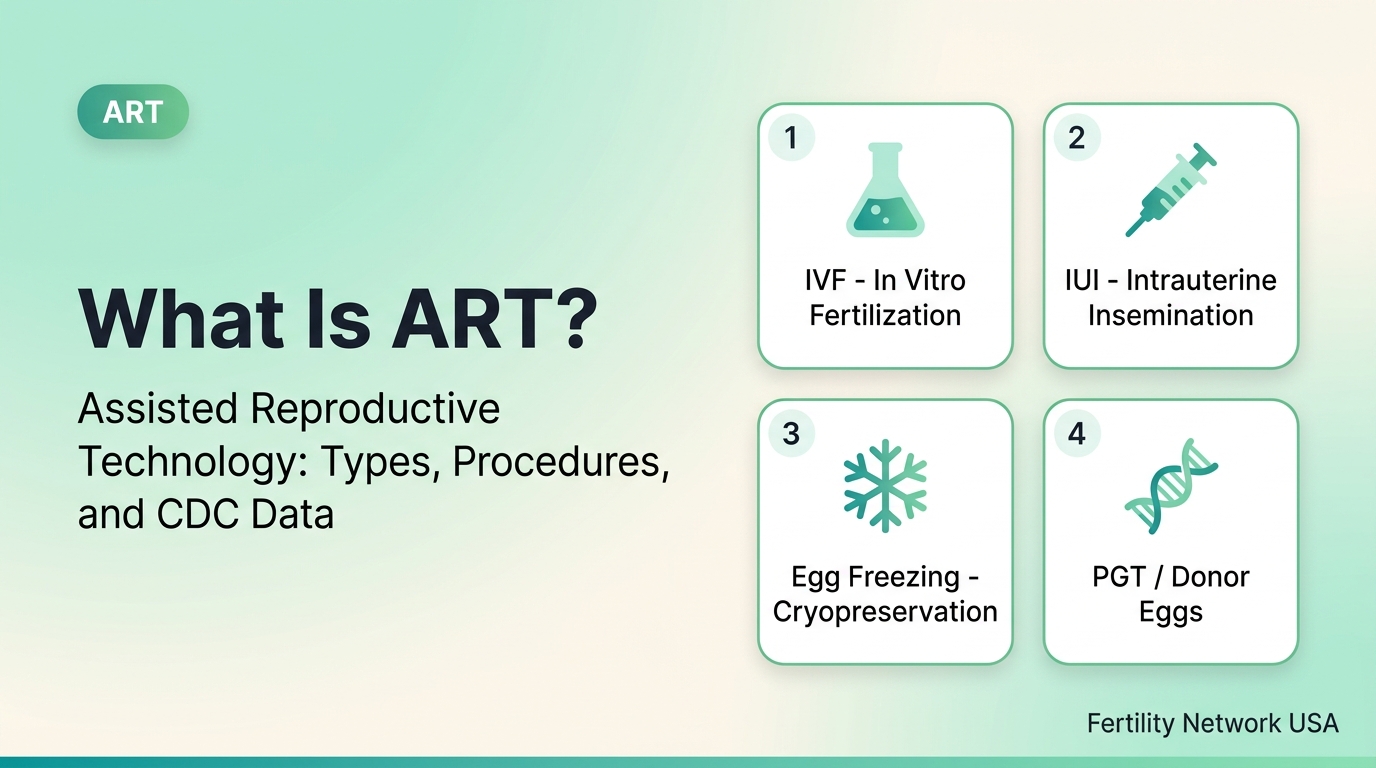
What is assisted reproductive technology (ART)?
Assisted reproductive technology (ART) is defined by the Centers for Disease Control and Prevention (CDC) as all fertility treatments in which either eggs or embryos are handled outside the body. The federal definition is codified under the Fertility Clinic Success Rate and Certification Act of 1992 (FCSRCA), which also mandates that all US ART clinics report annual outcome data to the CDC.
The key criterion distinguishing ART from other fertility treatments is the direct handling of eggs (oocytes) or embryos outside the body. Fertility treatments that only handle sperm — such as intrauterine insemination (IUI), ovulation induction with clomiphene citrate or letrozole, or gonadotropin injections without egg retrieval — are not classified as ART under the CDC definition.
ART was first defined in US federal law in 1992. Since then, the FCSRCA has required all fertility clinics performing ART to report cycle outcomes — including live birth rates, pregnancy rates, and miscarriage rates — to the CDC annually. The CDC audits, verifies, and publishes this data in the NASS Annual Report, approximately 2 years after the reporting cycle year.
What procedures are classified as ART by the CDC?
5 procedures are classified as ART by the CDC: in vitro fertilization (IVF), gamete intrafallopian transfer (GIFT), zygote intrafallopian transfer (ZIFT), frozen embryo transfer (FET), and oocyte cryopreservation (egg freezing). IVF accounts for 99% of all ART cycles performed in the United States; GIFT and ZIFT are rarely used today.
| ART Procedure | What Is Handled Outside the Body | US Cycle Volume (2022) | Status |
|---|---|---|---|
| IVF (In Vitro Fertilization) | Eggs + embryos | ~323,000 cycles (99%) | Active — primary ART procedure |
| FET (Frozen Embryo Transfer) | Cryopreserved embryos | Subset of IVF cycles | Active — majority of transfers are FET |
| Egg Freezing (Oocyte Cryopreservation) | Eggs (banking cycle) | Tracked separately as banking cycles | Active — rapidly growing |
| GIFT (Gamete Intrafallopian Transfer) | Eggs + sperm (placed in fallopian tube) | Fewer than 100 cycles/year | Rare — replaced by IVF |
| ZIFT (Zygote Intrafallopian Transfer) | Fertilized egg placed in fallopian tube | Fewer than 50 cycles/year | Rare — replaced by IVF |
The following techniques are used within IVF but are not separately classified as ART procedures — they are components of an IVF cycle: ICSI (intracytoplasmic sperm injection), PGT-A (preimplantation genetic testing for aneuploidies), PGT-M (preimplantation genetic testing for monogenic disease), assisted hatching, and embryo biopsy.
What is ICSI and is it classified as ART?
ICSI (intracytoplasmic sperm injection) is a fertilization technique performed within an IVF cycle — it is not a separately classified ART procedure. ICSI is used in approximately 79% of all IVF cycles in the United States (CDC NASS 2022). ICSI injects a single sperm directly into each mature egg in the laboratory, achieving a 70–80% fertilization rate per mature oocyte. For a full explanation, see What Is ICSI (Intracytoplasmic Sperm Injection)? Definition, Process, and Indications.
Is egg freezing (oocyte cryopreservation) classified as ART?
Egg freezing (oocyte cryopreservation) is classified as ART by the CDC because it involves the handling of eggs outside the body. The CDC tracks egg freezing cycles separately from pregnancy-intended IVF cycles, classifying them as banking cycles (cycles performed to preserve fertility for future use) versus non-banking cycles(cycles intended to achieve pregnancy in the current or near-term cycle). In 2022, banking cycles accounted for approximately 22% of all ART cycles reported to the CDC. For a full overview, see What Is Egg Freezing (Oocyte Cryopreservation)? Process, Success Rates, and Cost.
What is the difference between ART and fertility treatments like IUI?
ART procedures handle eggs or embryos outside the body; fertility treatments that only handle sperm are not classified as ART by the CDC. The critical distinction is whether eggs or embryos are removed from the body and manipulated in a laboratory.
| Treatment | Eggs/Embryos Handled Outside Body? | CDC Classification | Reported in NASS? |
|---|---|---|---|
| IVF | Yes — eggs retrieved + embryos cultured | ART | Yes |
| Egg freezing | Yes — eggs retrieved + vitrified | ART | Yes (banking cycle) |
| FET | Yes — frozen embryos thawed + transferred | ART | Yes |
| IUI (Intrauterine insemination) | No — only sperm are processed | Not ART | No |
| Ovulation induction | No — only stimulates ovulation | Not ART | No |
| Clomiphene / Letrozole | No — oral medication only | Not ART | No |
IUI (intrauterine insemination) is frequently confused with IVF because both are fertility treatments performed in a clinic. IUI places washed sperm directly into the uterus at ovulation — no eggs are retrieved, and no embryos are created in the laboratory. The IUI success rate is 10–20% per cycle for women under 40; IVF achieves 49.7% per retrieval for women under 35 (CDC NASS 2022). For a detailed comparison, see What Is IUI (Intrauterine Insemination)? Process, Success Rates, and Cost.
How many ART cycles are performed in the United States each year?
326,468 ART cycles were performed in the United States in 2022, resulting in 91,906 live-birth deliveries and 97,128 live-born infants, according to the CDC NASS 2022 Annual Report. ART cycle volume in the US has increased every year since 2012, growing from 165,172 cycles in 2012 to 326,468 in 2022 — a 98% increase over 10 years.
| Year | Total ART Cycles | Live-Birth Deliveries | Live-Born Infants |
|---|---|---|---|
| 2018 | 253,013 | 73,831 | 78,052 |
| 2019 | 265,636 | 77,998 | 83,946 |
| 2020 | 242,318 | 68,908 | 73,831 |
| 2021 | 304,721 | 86,146 | 91,906 |
| 2022 | 326,468 | 91,906 | 97,128 |
The 2020 decline in ART cycle volume reflects the temporary suspension of non-urgent fertility treatments during the COVID-19 pandemic following an ASRM recommendation issued in March 2020. Cycle volume rebounded sharply in 2021 and continued growing in 2022.
Of the 326,468 ART cycles performed in 2022, approximately 78% were non-banking cycles (intended to achieve pregnancy) and 22% were banking cycles (egg or embryo freezing for future use). The proportion of banking cycles has grown from 8% of all ART cycles in 2014 to 22% in 2022, reflecting rising demand for elective egg freezing for fertility preservation.
What is the CDC NASS report on ART?
The CDC National ART Surveillance System (NASS) Annual Report is the federally mandated dataset reporting ART cycle outcomes from every ART-performing clinic in the United States, published by the Division of Reproductive Health within the CDC's National Center for Chronic Disease Prevention and Health Promotion.
The NASS report is mandated by the Fertility Clinic Success Rate and Certification Act of 1992 (FCSRCA), which requires all US fertility clinics performing ART to submit complete cycle-level outcome data to the CDC. The CDC then performs data validation, statistical analysis, and publishes the results approximately 2 years after the reporting cycle year — meaning the 2022 report was published in 2024.
The NASS report breaks down success rates by 6 key variables: patient age group (under 35, 35–37, 38–40, 41–42, over 42), egg source (own egg vs. donor egg), cycle type (fresh vs. frozen), intended use (banking vs. non-banking), embryo transfer number, and clinic identity. Each clinic's data is published individually, allowing patients to compare their specific clinic's CDC-verified outcomes against national averages.
For a detailed guide on reading and interpreting CDC NASS data, see CDC ART Annual Report Explained: How to Read Clinic Success Rate Data.
What types of ART have the highest live birth rates?
IVF using donor eggs has the highest live birth rate per transfer of any ART procedure — 40–52% per transfer regardless of recipient age, according to CDC NASS 2022. Among own-egg IVF cycles, frozen embryo transfer (FET) of PGT-A-confirmed euploid blastocysts achieves the highest per-transfer live birth rates: 55–70% for patients aged 35–42.
| ART Procedure / Cycle Type | Patient Age | Live Birth Rate Per Transfer | Notes |
|---|---|---|---|
| Donor egg IVF — FET | Any age | 40–52% | Success depends on donor age, not recipient age |
| Own egg IVF — FET, euploid embryo (PGT-A) | Under 35 | 60–70% | Best-case own-egg outcome |
| Own egg IVF — FET | Under 35 | 51.2% | CDC NASS 2022 national average |
| Own egg IVF — Fresh transfer | Under 35 | 44.8% | Lower than FET due to stimulation effect |
| Own egg IVF — FET | 38–40 | 27.8% | CDC NASS 2022 national average |
| Own egg IVF — FET, euploid embryo (PGT-A) | 38–40 | 55–65% | Euploid-only selection significantly improves outcomes |
| Own egg IVF — any transfer | Over 42 | 8.1% | CDC NASS 2022; very high aneuploidy rate |
GIFT and ZIFT — historically used in the 1980s and 1990s — are now rarely performed because IVF with FET achieves equal or superior live birth rates with less surgical risk. GIFT required laparoscopic surgery to place eggs and sperm in the fallopian tube; ZIFT required laparoscopy to transfer a fertilized egg. IVF with transcervical embryo transfer requires no surgery.
Who performs ART procedures in the United States?
ART procedures are performed by board-certified reproductive endocrinologists (REIs) with the embryology laboratory component performed by clinical embryologists. REIs are physicians who complete a 4-year OB/GYN residency followed by a 3-year fellowship in reproductive endocrinology and infertility, accredited by the Accreditation Council for Graduate Medical Education (ACGME).
The clinical team in an ART cycle includes 4 specialist roles: the reproductive endocrinologist (who manages ovarian stimulation, performs egg retrieval, and performs embryo transfer), the clinical embryologist (who fertilizes eggs, cultures embryos, and performs biopsy for PGT-A), the reproductive endocrinology nurse coordinator (who manages patient monitoring and medication protocols), and the andrologist (who processes semen samples for IVF or ICSI).
| Role | Credential | ART Responsibilities |
|---|---|---|
| Reproductive Endocrinologist (REI) | MD/DO + ACGME REI fellowship + ABOG board certification | Stimulation protocol, retrieval, transfer, patient counseling |
| Clinical Embryologist | MS or PhD in reproductive biology + HCLD/ELD certification | Fertilization (IVF/ICSI), embryo culture, blastocyst grading, PGT-A biopsy, cryopreservation |
| Andrologist | BS/MS in biology + AABB certification | Semen analysis, sperm preparation, sperm banking |
| REI Nurse Coordinator | RN + REI specialty training | Monitoring coordination, medication instruction, patient communication |
In 2022, 449 fertility clinics in the United States reported ART outcomes to the CDC. Clinic accreditation is voluntary and is offered through the College of American Pathologists (CAP) for ART laboratories. ASRM membership and SART (Society for Assisted Reproductive Technology) membership are also voluntary but indicate adherence to clinical and laboratory practice guidelines.
Frequently Asked Questions
What percentage of US births come from ART?+
ART accounted for approximately 2.3% of all births in the United States in 2022, based on 97,128 ART live-born infants out of approximately 3.66 million total US births (CDC NASS 2022; CDC National Center for Health Statistics). This proportion has grown steadily from 1.6% in 2012, driven by rising ART cycle volume and an increasing proportion of patients delaying childbearing to their mid-to-late 30s.
Are ART babies at higher risk of birth defects?+
ART is associated with a modestly elevated birth defect rate of 4–5%, compared to approximately 3% for spontaneous pregnancies. This elevated rate is partly attributable to the underlying infertility diagnosis — not the ART procedure itself — and to the higher proportion of multiple pregnancies historically associated with ART before the adoption of single embryo transfer (SET) guidelines. With modern SET protocols, the birth defect risk difference between ART and spontaneous conception is reduced significantly (ASRM 2023; ESHRE 2022).
Does ART increase the risk of multiple pregnancy?+
ART multiple pregnancy rates have declined from 32% of ART births in 2011 to below 10% in 2022, driven by the widespread adoption of single embryo transfer (SET) (CDC NASS 2022). Transferring 2 or more embryos simultaneously increases twin pregnancy risk to 20–30% and triplet risk to 2–5%. ASRM recommends SET for most patients under 38 with good-quality blastocysts to eliminate the additional maternal and neonatal risks of multiple gestation.
How long has ART been performed in the United States?+
The first US IVF birth took place on December 28, 1981, at the Eastern Virginia Medical School in Norfolk, Virginia, when Elizabeth Jordan Carr was born. Federal regulation of ART began with the passage of the Fertility Clinic Success Rate and Certification Act (FCSRCA) in 1992, which mandated outcome reporting to the CDC starting with 1995 cycle data. Since then, over 1.5 million ART babies have been born in the United States.
What is the difference between ART and third-party reproduction?+
Third-party reproduction is a subset of ART in which eggs, sperm, or embryos are donated by a third party, or in which a gestational carrier carries the pregnancy. Third-party ART procedures include donor egg IVF, donor sperm IVF or IUI, donor embryo transfer, and gestational surrogacy. In 2022, donor egg cycles accounted for approximately 11% of all non-banking ART cycles reported to the CDC (CDC NASS 2022). All third-party ART procedures that handle eggs or embryos are classified as ART and are included in CDC NASS reporting.
Fertility Network USA is an independent information directory. All cycle volume figures, live birth rates, and success rate data in this article are sourced directly from the CDC National ART Surveillance System (NASS) 2022 Annual Report and the Fertility Clinic Success Rate and Certification Act of 1992 (42 U.S.C. § 263a-7). Clinical credential requirements are sourced from ACGME, ABOG, and CAP published standards. This article does not constitute medical advice, a diagnosis, or a treatment recommendation. Always consult a board-certified reproductive endocrinologist before making fertility treatment decisions.